

Why do some ecommerce brands keep growing year after year while others disappear after a few months?
It is not always about having the best product.
Many ecommerce stores start strong. They run ads, offer discounts, get traffic, and make sales.
Then growth starts to slow.
Advertising becomes more expensive. Competition increases. Customers stop returning as often.
This is where ecommerce brand building becomes important.
A strong brand gives customers a reason to choose your business beyond price or promotions.
It builds trust.
It creates loyalty.
And it helps customers remember your business when they are ready to buy again.
Over time, these experiences create brand equity. This is the value your brand builds through awareness, trust, customer experience, and loyalty.
Successful ecommerce brands do not focus only on the next sale. They focus on building long-term relationships with their customers.
In this guide, you will learn how to build a strong ecommerce brand through brand awareness, customer loyalty, community, advocacy, consistency, and long-term brand growth.
Because products may bring customers in.
A strong brand gives them a reason to come back.
Section 1: What Is Ecommerce Brand Building?
Many ecommerce business owners believe brand building starts when a company becomes large.
They think branding is something businesses focus on after reaching a certain level of success.
In reality, the opposite is often true.
The brands that grow the most are usually the ones that start building their brand from the very beginning.
Imagine two ecommerce stores selling similar products.
The first store focuses entirely on generating sales.
Its goal is simple: attract visitors and convert them as quickly as possible.
The second store also wants sales, but it focuses on something bigger.
It wants customers to remember the brand, trust the business, and return in the future.
A year later, which store is more likely to have loyal customers, stronger recognition, and sustainable growth?
Most likely the second one.
That’s the power of ecommerce brand building.
It’s not just about making sales today.
It’s about creating a business customers want to buy from tomorrow, next month, and next year.
To understand how long-term growth happens, we first need to understand what brand building really means.
1.1 Defining Brand Building
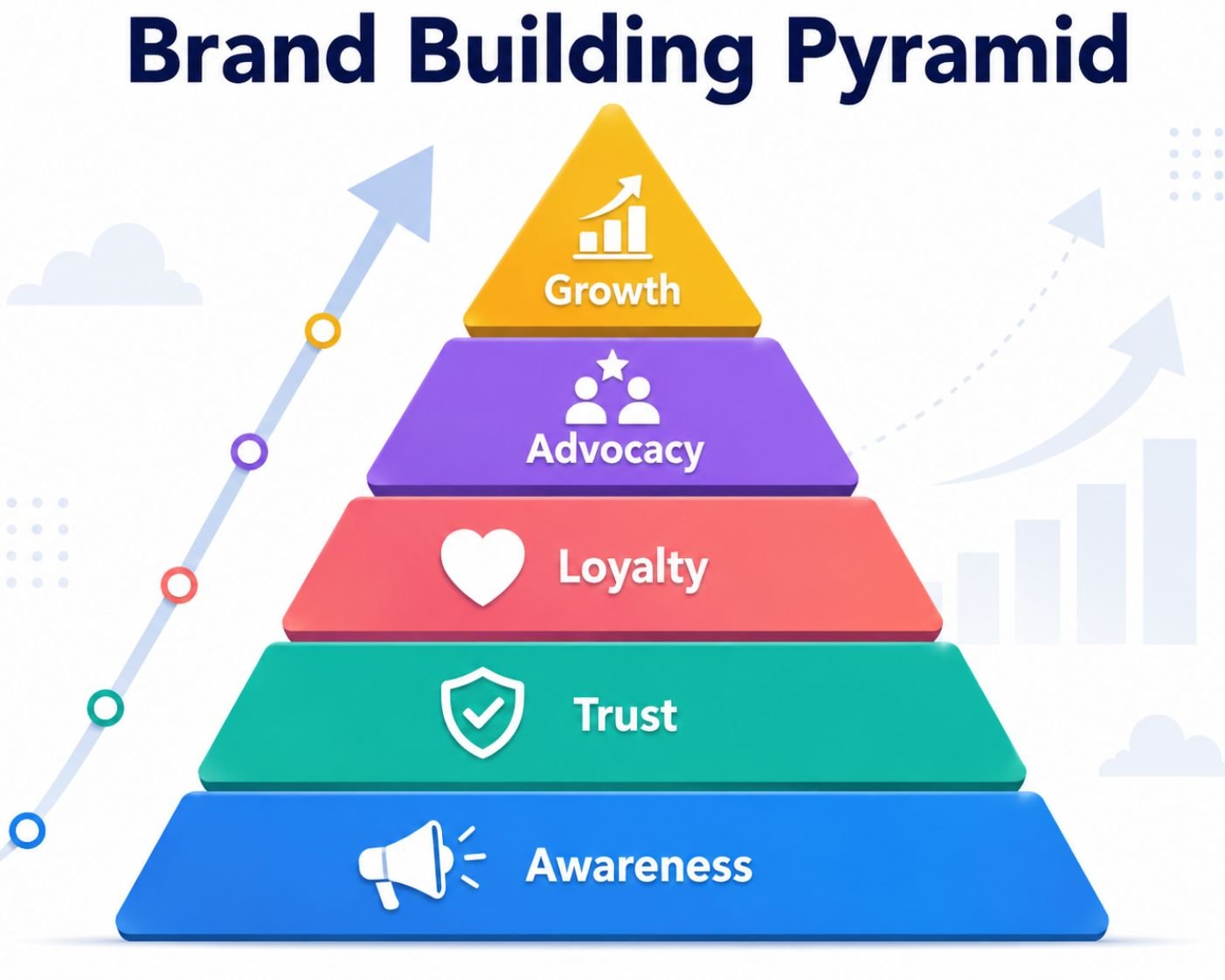
Ecommerce brand building is the process of creating a recognizable, trusted, and memorable business that customers choose repeatedly over competitors.
It’s about shaping how people perceive your brand.
When people hear the word “brand,” they often think about logos, colors, or packaging.
While those elements matter, brand building goes much deeper.
Your brand is the overall impression customers have of your business.
It’s what people think, feel, and remember when they interact with your company.
For example, imagine a customer purchasing from an online skincare store.
The website is easy to navigate.
The products arrive on time.
Customer support is helpful.
The packaging feels professional.
Every interaction creates a positive impression.
Over time, those experiences form the customer’s perception of the brand.
That’s brand building in action.
Every customer interaction contributes to how your business is viewed.
The goal is to create positive experiences that strengthen recognition, trust, and loyalty over time.
Strong ecommerce brand building helps businesses become more than just another online store.
It helps them become the preferred choice in their market.
1.2 Brand Building vs Marketing
One of the biggest misconceptions in ecommerce is assuming that brand building and marketing are the same thing.
They are closely connected, but they serve different purposes.
Marketing focuses on attracting attention and generating action.
Brand building focuses on shaping perception and creating long-term value.
Think about it this way:
Marketing helps customers discover your business.
Brand building gives them a reason to remember it.
Imagine running a Facebook advertising campaign.
The ads generate traffic and sales.
That’s marketing.
But what happens after customers arrive?
How do they feel about the business?
Do they trust it?
Will they remember it?
Will they return?
Those questions relate to brand building.
Marketing often produces short-term results.
Brand building creates long-term assets.
The strongest ecommerce businesses don’t choose between marketing and brand building.
They combine both.
Marketing brings people in.
Brand building keeps them connected.
Together, they create sustainable growth.
1.3 Brand Building vs Selling
Another common mistake is confusing brand building with selling.
Selling focuses on completing transactions.
Brand building focuses on creating relationships.
Imagine visiting an ecommerce website where every message is designed to push a sale.
Discounts everywhere.
Urgent promotions.
Constant pressure to buy.
Some customers may convert.
Many others may leave.
Now imagine a brand that focuses on helping customers solve problems, educating them, and creating positive experiences.
Sales still happen, but the approach feels different.
The relationship feels stronger.
This is because brand building extends beyond individual transactions.
It focuses on long-term customer value.
A customer who buys once is valuable.
A customer who buys repeatedly, recommends the brand, and becomes an advocate is far more valuable.
Selling creates customers.
Brand building creates loyal customers.
The most successful ecommerce brands understand that every sale should strengthen the relationship rather than simply generate revenue.
1.4 Why Long-Term Growth Matters
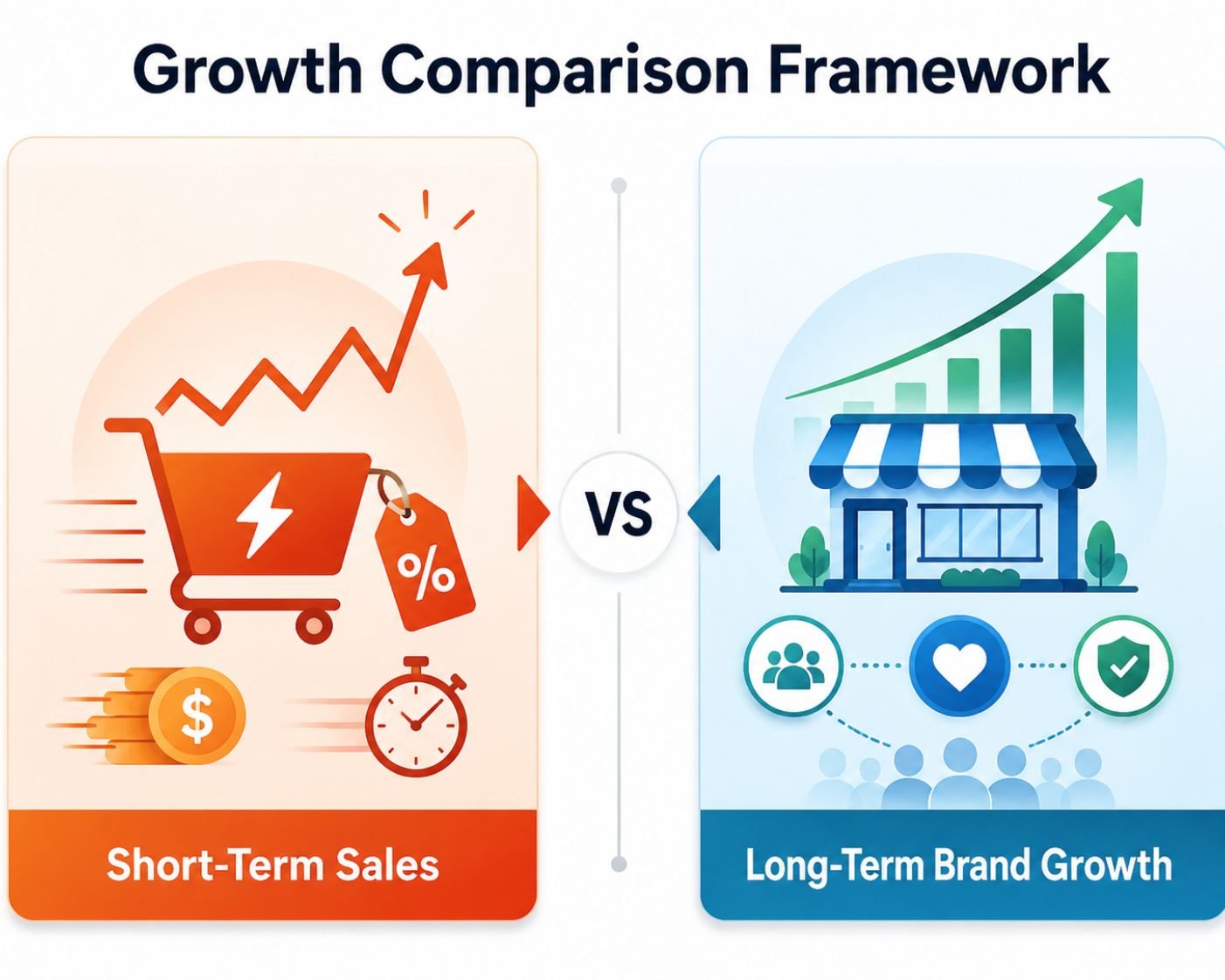
In ecommerce, it’s relatively easy to generate short-term sales.
You can launch promotions, run advertisements, offer discounts, or create limited-time offers.
These tactics often work.
The challenge is sustaining growth.
Imagine an ecommerce business that relies entirely on advertising.
Every month, it must spend more money to attract new customers.
If advertising stops, sales decline.
This creates a cycle of dependency.
Now imagine a brand with strong awareness, loyal customers, positive reviews, and a trusted reputation.
Customers return without needing constant incentives.
They recommend the business to others.
Word-of-mouth marketing begins working alongside paid marketing.
Growth becomes more sustainable.
This is why long-term growth matters.
Strong brands accumulate value over time.
Every satisfied customer strengthens the business.
Every positive experience builds trust.
Every repeat purchase increases customer lifetime value.
Over time, these small gains compound into significant advantages.
This is what ecommerce brand building ultimately achieves.
It transforms growth from a series of short-term sales spikes into a sustainable system that continues creating value year after year.
The strongest ecommerce brands don’t just focus on today’s revenue.
They focus on building a brand that customers will remember, trust, and support for years to come.
Section 2: Why Long-Term Brand Growth Matters
Imagine two ecommerce businesses launching at the same time.
Both sell similar products.
Both invest in advertising.
Both generate their first sales within a few weeks.
At first, their growth looks almost identical.
But a few years later, their situations are very different.
The first business is constantly chasing new customers. It relies heavily on discounts, promotions, and paid advertising to maintain sales. The moment marketing efforts slow down, revenue starts to decline.
The second business continues growing steadily. Customers return regularly. Word-of-mouth referrals generate new sales. Brand recognition increases year after year.
What created the difference?
The answer is long-term brand growth.
Many ecommerce businesses focus almost entirely on short-term results. While generating immediate sales is important, sustainable success requires something bigger.
It requires building a brand that continues creating value long after individual marketing campaigns end.
Let’s explore why long-term brand growth matters and why it should be a priority for every ecommerce business.
2.1 The Problem With Short-Term Thinking
One of the most common mistakes in ecommerce is focusing exclusively on short-term sales.
It’s easy to understand why.
Sales numbers are visible.
Advertising results are measurable.
Promotions often produce immediate outcomes.
As a result, many businesses become obsessed with quick wins.
Imagine an online store running discounts every month.
Sales increase during promotions.
Traffic spikes.
Revenue looks healthy.
But what happens when the discounts stop?
Customers disappear.
Sales decline.
The business becomes dependent on constant incentives.
This is the problem with short-term thinking.
It prioritizes immediate results while ignoring long-term brand value.
Many businesses end up trapped in a cycle where they must continuously spend more on advertising and promotions just to maintain the same level of growth.
Over time, this becomes expensive and difficult to sustain.
Strong brands take a different approach.
They focus on building customer relationships, trust, recognition, and loyalty alongside sales generation.
As a result, growth becomes less dependent on temporary marketing tactics.
2.2 Sustainable Growth vs Temporary Growth
Not all growth is created equal.
Some growth lasts.
Some growth disappears as quickly as it arrives.
Imagine an ecommerce business experiencing a surge in sales because of a viral social media post.
For a few weeks, orders increase dramatically.
The business celebrates the success.
But after the excitement fades, sales return to previous levels.
This is an example of temporary growth.
Temporary growth can be valuable, but it doesn’t always create lasting business strength.
Now imagine a different scenario.
A business steadily improves customer experience, strengthens brand awareness, earns customer trust, and increases loyalty over time.
Sales continue growing year after year.
Customers keep returning.
Referrals increase.
Brand recognition expands.
This is sustainable growth.
The difference is important.
Temporary growth often depends on external events.
Sustainable growth comes from systems that continue producing results over time.
Strong ecommerce brands focus on creating assets that compound.
Every positive customer experience strengthens the brand.
Every loyal customer increases future revenue opportunities.
Every recommendation introduces new customers to the business.
Growth becomes cumulative rather than temporary.
2.3 Competitive Advantages of Strong Brands
Competition is one of the biggest challenges in ecommerce.
New stores launch every day.
Products can often be copied.
Prices can be matched.
Advertising strategies can be replicated.
Brand strength is much harder to copy.
Imagine two businesses selling similar products at similar prices.
One has little recognition and limited customer loyalty.
The other has a trusted reputation, loyal customers, and strong brand awareness.
Which business has the advantage?
Most likely the second one.
Strong brands create competitive advantages that extend beyond products.
These advantages may include:
- Customer trust
- Brand recognition
- Customer loyalty
- Community engagement
- Positive reputation
- Word-of-mouth marketing
For example, many customers willingly choose familiar brands even when cheaper alternatives exist.
The decision isn’t always based on product features.
It’s often based on confidence and familiarity.
This is why strong brands are often more resilient during economic changes, increased competition, and market uncertainty.
Customers stay connected because the relationship extends beyond a single transaction.
2.4 Long-Term Business Value
One of the most overlooked benefits of brand building is the value it creates over time.
Every positive customer interaction contributes to a larger asset.
That asset is your brand.
Imagine a business that consistently delivers excellent experiences.
Customers leave positive reviews.
They recommend the company to others.
They return repeatedly.
Over time, the business develops strong brand equity.
This creates value in several ways.
Customer acquisition becomes easier.
Retention improves.
Marketing becomes more effective.
Revenue becomes more predictable.
Growth becomes more sustainable.
Think of brand building as planting a tree.
In the beginning, growth may seem slow.
Results may not be immediately visible.
But with consistent effort, the tree grows stronger every year.
Eventually, it produces benefits that continue long into the future.
The same principle applies to ecommerce brands.
The strongest businesses aren’t built solely on products or advertising campaigns.
They’re built on years of trust, loyalty, recognition, and positive customer experiences.
Ultimately, long-term brand growth matters because it creates stability, resilience, and sustainable success. While short-term sales can generate immediate revenue, strong brands generate value that compounds over time.
By focusing on sustainable growth, building competitive advantages, and investing in long-term brand equity, ecommerce businesses position themselves for success that extends far beyond the next marketing campaign or sales promotion.
Section 3: Building Brand Equity
Imagine two ecommerce stores selling nearly identical products.
Both offer competitive prices.
Both have professional websites.
Both invest in marketing.
Yet one store consistently attracts more customers, earns more repeat purchases, and grows faster over time.
Why?
Because customers perceive the two brands differently.
One brand has earned something incredibly valuable that goes far beyond products or pricing.
It has built brand equity.
Brand equity is one of the most important assets an ecommerce business can develop. It influences how customers view your brand, how much they trust your products, and whether they choose you over competitors.
The challenge is that many business owners focus heavily on sales and marketing while overlooking the long-term value of building brand equity.
Let’s explore what brand equity is, how it’s created, and why it plays such a critical role in sustainable ecommerce growth.

3.1 What Is Brand Equity?
Simply put, brand equity is the value your brand holds in the minds of customers.
It’s the collection of perceptions, experiences, emotions, and expectations people associate with your business.
Think about some of your favorite brands.
When you hear their names, certain thoughts immediately come to mind.
You may think about quality.
Trust.
Reliability.
Innovation.
Customer service.
Those associations represent brand equity.
In ecommerce, brand equity develops when customers consistently experience positive interactions with a business.
It’s what makes customers choose one brand over another, even when alternatives are available.
For example, imagine shopping for athletic shoes online.
You find two options with similar features and prices.
One comes from a brand you’ve never heard of.
The other comes from a brand you recognize and trust.
Which one are you more likely to choose?
Most customers select the familiar brand.
Not necessarily because the product is better, but because the brand has already earned credibility.
That’s brand equity in action.
It creates confidence before the purchase even happens.
Strong brand equity allows ecommerce businesses to become more than product sellers.
They become trusted brands that customers actively seek out.
3.2 How Brand Equity Is Created
Brand equity doesn’t appear overnight.
It develops gradually through consistent customer experiences.
Every interaction either strengthens or weakens the way customers perceive your brand.
Imagine a customer discovering your business for the first time.
They visit your website.
Browse products.
Read reviews.
Make a purchase.
Receive customer support.
Interact with your social media content.
Each of these touchpoints contributes to the customer’s perception of the brand.
Over time, those experiences accumulate.
Positive experiences strengthen brand equity.
Negative experiences weaken it.
Several factors play important roles in building brand equity:
- Brand awareness
- Customer trust
- Product quality
- Customer experience
- Consistency
- Brand identity
- Customer loyalty
Think about the ecommerce branding journey you’ve explored throughout this ebook.
A strong foundation creates clarity.
A clear identity creates recognition.
Trust creates confidence.
Loyalty creates repeat customers.
Together, these elements contribute to brand equity.
This is why brand equity should not be viewed as a separate activity.
It’s the result of consistently executing every aspect of branding well.
The stronger the customer experience, the stronger the brand equity becomes.
3.3 Benefits of Strong Brand Equity
Many ecommerce business owners ask an important question:
“What does brand equity actually do for my business?”
The answer is simple.
Strong brand equity makes growth easier.
When customers recognize and trust your brand, many business challenges become easier to overcome.
For example, strong brand equity can help:
- Increase customer loyalty
- Improve repeat purchase rates
- Strengthen customer trust
- Reduce customer acquisition costs
- Improve conversion rates
- Support premium pricing
- Encourage referrals
Imagine launching a new product.
A business with weak brand equity must work hard to convince customers to try it.
A business with strong brand equity starts with an advantage because customers already trust the brand.
The same principle applies to marketing.
When people recognize and trust your business, marketing efforts often become more effective.
Customers are more willing to click, engage, and purchase.
Strong brand equity also creates resilience.
During periods of increased competition or market uncertainty, trusted brands often maintain stronger customer relationships than lesser-known alternatives.
This makes long-term growth more sustainable.
3.4 Examples of Brand Equity in Ecommerce
Brand equity can sometimes feel like an abstract concept until you see it in action.
Let’s consider a simple example.
Imagine two online coffee brands.
Both sell high-quality coffee.
Both use similar ingredients.
Both offer comparable pricing.
However, one brand has spent years building trust, creating a memorable identity, delivering excellent customer experiences, and developing a loyal customer base.
Customers recognize the brand immediately.
They recommend it to friends.
They return regularly.
When the company launches a new coffee blend, customers are eager to try it.
The second brand may have excellent products, but it lacks the same recognition and trust.
As a result, growth becomes more difficult.
The difference between these businesses is not just product quality.
It’s brand equity.
You can find similar examples throughout ecommerce.
Some brands become customer favorites because they’ve consistently delivered positive experiences over time.
Customers don’t simply purchase their products.
They develop confidence in the brand itself.
That’s the ultimate goal of ecommerce brand building.
To create a business that customers remember, trust, and choose repeatedly.
Ultimately, brand equity is one of the most powerful drivers of long-term ecommerce growth. It is built through awareness, trust, consistency, customer experience, and loyalty.
While products may attract attention initially, brand equity is what keeps customers coming back. The stronger your brand equity becomes, the easier it is to earn trust, retain customers, and create sustainable growth that compounds year after year.
Section 4: Increasing Brand Awareness Strategically
Imagine creating an amazing ecommerce brand.
Your products are excellent.
Your website looks professional.
Your customer service is responsive.
Your branding is consistent.
There’s just one problem.
Very few people know your business exists.
No matter how strong your products or customer experience may be, growth becomes difficult when potential customers have never heard of your brand.
This is why brand awareness plays such an important role in ecommerce brand building.
Before customers can trust your brand, buy your products, or become loyal advocates, they must first discover you.
However, successful ecommerce brands don’t chase awareness randomly.
They build it strategically.
They focus on attracting the right audience, appearing in the right places, and creating visibility that supports long-term growth rather than temporary attention.
Let’s explore some of the most effective ways to increase ecommerce brand awareness.

4.1 Organic Brand Awareness
Organic brand awareness refers to visibility that grows naturally without directly paying for every interaction.
It often takes longer to build than paid awareness, but the results can be incredibly valuable.
Imagine searching online for a product solution and discovering a helpful article from an ecommerce brand.
You read the content.
Learn something useful.
Remember the company.
Weeks later, when you’re ready to buy, that brand comes to mind.
That’s organic awareness at work.
It develops when customers repeatedly encounter your brand through valuable experiences.
Common sources of organic brand awareness include:
- Search engine optimization (SEO)
- Blog content
- Customer referrals
- User-generated content
- Social media engagement
- Online communities
For example, a fitness equipment store that regularly publishes workout guides may gradually attract thousands of potential customers through search engines.
Those visitors may not purchase immediately.
However, every interaction increases familiarity with the brand.
Over time, awareness compounds.
One of the biggest advantages of organic awareness is sustainability.
Unlike advertising campaigns that stop generating results when budgets end, organic visibility can continue creating value for months or even years.
4.2 Paid Brand Awareness
Organic growth is powerful, but it can take time.
This is where paid brand awareness can accelerate growth.
Paid awareness involves using advertising platforms to introduce your brand to potential customers.
Imagine launching a new ecommerce business.
Very few people know your brand exists.
Running targeted advertisements can help place your business in front of relevant audiences much faster than waiting for organic discovery alone.
Common paid awareness channels include:
- Social media advertising
- Search engine advertising
- Display advertising
- Influencer collaborations
- Video advertising
For example, a new skincare brand might use Instagram or Facebook ads to showcase products to audiences interested in beauty and skincare.
The goal isn’t always immediate sales.
Sometimes the goal is simply visibility.
Successful ecommerce brands understand that awareness often comes before conversion.
Customers may need multiple interactions before feeling ready to purchase.
Paid advertising helps create those initial touchpoints.
However, paid awareness works best when supported by strong branding.
Driving traffic to a weak brand rarely produces long-term results.
Driving traffic to a memorable brand creates opportunities for sustainable growth.
4.3 Content Marketing
One of the most effective long-term awareness strategies is content marketing.
Why?
Because content helps brands become useful before they become sellers.
Imagine you’re researching how to improve your home office setup.
You discover an ecommerce brand that publishes detailed guides, helpful videos, and practical advice.
Even if you don’t buy immediately, you’ve gained value from the interaction.
The brand has earned your attention.
This is the strength of content marketing.
Instead of constantly asking customers to buy, it focuses on educating, informing, and helping them.
Examples of content marketing include
- Blog articles
- Buying guides
- Tutorials
- Videos
- Case studies
- Email newsletters
For instance, an ecommerce coffee brand might publish brewing guides, coffee bean comparisons, and expert tips.
Over time, customers begin associating the brand with expertise and value.
As awareness grows, trust often follows.
This is why content marketing remains one of the most powerful tools for ecommerce brand growth.
4.4 Social Media Visibility
Social media has become one of the most important channels for ecommerce brand awareness.
Customers spend significant amounts of time on platforms such as Instagram, Facebook, TikTok, YouTube, Pinterest, and LinkedIn.
As a result, these platforms provide valuable opportunities to increase visibility.
Imagine discovering a new brand through a short video.
A few days later, you see another post.
Then a customer review appears.
Over time, the brand becomes familiar.
This process happens constantly on social media.
Visibility often grows through repeated exposure.
Successful ecommerce brands use social media to:
- Share valuable content
- Showcase products
- Highlight customer experiences
- Build community engagement
- Strengthen brand personality
The goal isn’t simply posting more content.
The goal is creating memorable interactions that help people remember your brand.
Consistency is especially important.
A strong social media presence helps keep your brand visible even when customers aren’t actively shopping.
4.5 Partnership Opportunities
Sometimes the fastest way to increase brand awareness is by borrowing trust and visibility from others.
This is where partnerships become valuable.
Imagine a small ecommerce business partnering with a respected creator, complementary brand, or industry expert.
Suddenly, the brand gains access to a larger audience that may never have discovered it otherwise.
Partnership opportunities can include:
- Influencer collaborations
- Affiliate partnerships
- Brand collaborations
- Guest content opportunities
- Community sponsorships
For example, an ecommerce fitness brand might collaborate with a fitness coach who already has an engaged audience.
The partnership benefits both parties while introducing the brand to potential customers who are already interested in the niche.
The key is alignment.
The strongest partnerships connect brands with audiences that genuinely match their products, values, and goals.
When done correctly, partnerships can accelerate awareness while also strengthening credibility.
Ultimately, brand awareness is the foundation of long-term ecommerce growth. Before customers can trust your brand, become loyal buyers, or recommend your products, they must first know you exist.
By combining organic visibility, paid promotion, content marketing, social media engagement, and strategic partnerships, ecommerce businesses can steadily expand their reach and create awareness that supports sustainable growth for years to come.
Section 5: Strengthening Customer Loyalty
Many ecommerce businesses spend most of their time trying to attract new customers.
They invest in advertising.
They focus on increasing traffic.
They launch campaigns designed to generate more clicks and more sales.
While acquiring new customers is important, there’s a question every ecommerce business should ask:
What happens after the first purchase?
Imagine two online stores.
The first store constantly attracts new customers but struggles to bring them back.
The second store attracts fewer customers initially, but a large percentage return again and again.
Over time, which business is likely to grow faster?
In most cases, the second one.
Why?
Because sustainable growth is built on customer loyalty.
The strongest ecommerce brands don’t rely solely on finding new customers every month. They create experiences that encourage existing customers to return, purchase again, and develop long-term relationships with the brand.
This is why customer loyalty is one of the most powerful drivers of ecommerce brand growth.
Let’s explore how loyalty fuels growth and how businesses can strengthen it over time.
5.1 Why Loyalty Fuels Growth
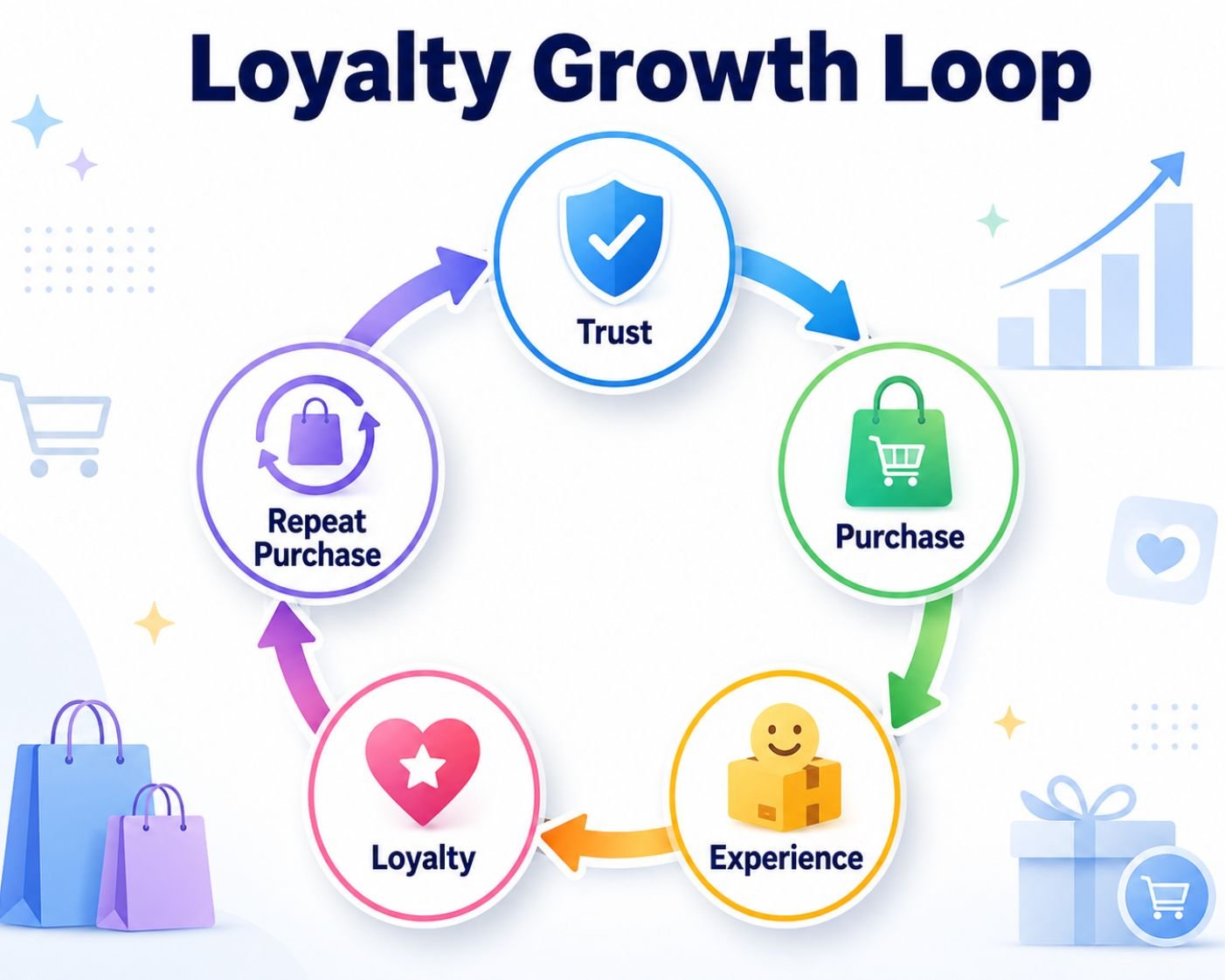
Customer loyalty is valuable because loyal customers contribute far more than a single purchase.
Think about your favorite brands.
You probably don’t evaluate every alternative each time you need a product.
Instead, you return to brands you already trust.
That’s exactly what ecommerce businesses want to achieve.
When customers become loyal, purchasing decisions become easier.
They already know the brand.
They trust the products.
They feel confident about the experience.
As a result, they’re more likely to buy again.
Loyal customers often provide several benefits:
- Higher lifetime value
- More repeat purchases
- Stronger referrals
- Better engagement
- Greater trust
For example, imagine a customer who purchases from a skincare brand once.
That’s valuable.
Now imagine a customer who purchases every few months for several years while recommending the brand to friends.
The difference in long-term value is enormous.
This is why loyalty should be viewed as a growth strategy rather than simply a customer retention metric.
Strong loyalty creates a foundation for sustainable ecommerce growth.
5.2 Retaining Existing Customers
One of the biggest opportunities in ecommerce is improving customer retention.
Many businesses work hard to acquire customers but spend very little effort keeping them.
Imagine filling a bucket with water while a hole in the bottom allows water to escape.
No matter how much water you add, growth remains difficult.
Customer retention works the same way.
If customers leave after a single purchase, businesses must continuously replace them with new ones.
This creates unnecessary pressure on marketing budgets.
Retention helps solve that problem.
The goal is to keep valuable customers engaged after the initial sale.
Loyal customers often provide several benefits:
- Higher lifetime value
- More repeat purchases
- Stronger referrals
- Better engagement
- Greater trust
For example, a fitness equipment brand might send workout tips after a purchase.
A skincare company might provide usage guidance and product recommendations.
These interactions continue the relationship beyond the transaction.
Customers feel supported rather than forgotten.
And when customers feel valued, they’re more likely to return.
5.3 Loyalty Programs
Loyalty programs are one of the most common tools for encouraging repeat purchases.
However, the most successful loyalty programs do more than offer rewards.
They strengthen customer relationships.
Imagine buying coffee from the same company repeatedly.
Each purchase earns points.
Eventually, those points unlock discounts, exclusive products, or special perks.
The rewards encourage continued engagement.
At the same time, customers feel recognized for their loyalty.
This creates a positive cycle.
The customer receives value.
The business earns repeat purchases.
Common loyalty program incentives include:
- Points systems
- Exclusive discounts
- VIP memberships
- Early access to products
- Birthday rewards
- Referral bonuses
The most effective programs align rewards with customer interests.
The goal isn’t simply giving away discounts.
The goal is creating additional reasons for customers to stay connected to the brand.
When designed well, loyalty programs can strengthen retention while improving overall customer satisfaction.
5.4 Customer Experience Improvements
Customer loyalty is rarely built through rewards alone.
It is usually built through experiences.
Think about the brands you continue buying from.
Chances are, the experience feels easy, reliable, and enjoyable.
The website works smoothly.
Products arrive as expected.
Customer service is helpful.
Communication is clear.
These factors may seem small individually, but together they shape how customers feel about a brand.
Imagine two ecommerce businesses selling similar products.
One consistently delivers excellent experiences.
The other creates frequent frustrations.
Which brand is more likely to retain customers?
The answer is obvious.
This is why improving customer experience should be a continuous process.
Areas worth optimizing include:
- Website usability
- Checkout experience
- Delivery process
- Product quality
- Customer support
- Post-purchase communication
Every improvement strengthens customer confidence and increases the likelihood of future purchases.
Over time, these positive experiences become a major source of loyalty.
5.5 Repeat Purchase Strategies
One of the clearest signs of customer loyalty is repeat purchasing.
The challenge is encouraging customers to return at the right time.
Imagine purchasing a product that naturally needs replacement after a few months.
If the brand reminds you at the appropriate moment, the next purchase becomes easy.
If the brand disappears completely after the first order, you may end up buying elsewhere.
This is why repeat purchase strategies matter.
Successful ecommerce brands actively encourage customers to come back through:
- Email marketing
- Product replenishment reminders
- Personalized recommendations
- Subscription programs
- Exclusive customer offers
For example, a coffee brand might send a reminder when a customer’s supply is likely running low.
A supplement company may recommend a reorder based on previous purchasing behavior.
These strategies work because they’re relevant.
Rather than pushing random products, they help customers solve ongoing needs.
The easier it becomes for customers to repurchase, the more likely they are to remain loyal.
Ultimately, customer loyalty is one of the most powerful growth assets an ecommerce business can build. Loyal customers purchase more frequently, stay engaged longer, and often become advocates for the brand.
By improving retention, implementing thoughtful loyalty programs, enhancing customer experiences, and encouraging repeat purchases, ecommerce businesses can create stronger customer relationships that support sustainable growth year after year.
Section 6: Building Brand Communities
Imagine two ecommerce brands selling similar products.
The first brand has customers.
The second brand has a community.
Customers buy from the first brand when they need something.
People support the second brand because they feel connected to it.
They engage with its content.
They interact with other customers.
They share experiences, recommendations, and feedback.
Over time, the relationship becomes much deeper than a simple transaction.
This is the power of a brand community.
As ecommerce becomes increasingly competitive, products and pricing alone are often not enough to create long-term growth. Strong brands build something more valuable: a sense of belonging.
When customers feel connected to a brand and the people around it, loyalty becomes stronger, engagement increases, and advocacy happens more naturally.
That’s why brand communities have become one of the most powerful tools for sustainable ecommerce growth.
6.1 What Is a Brand Community?
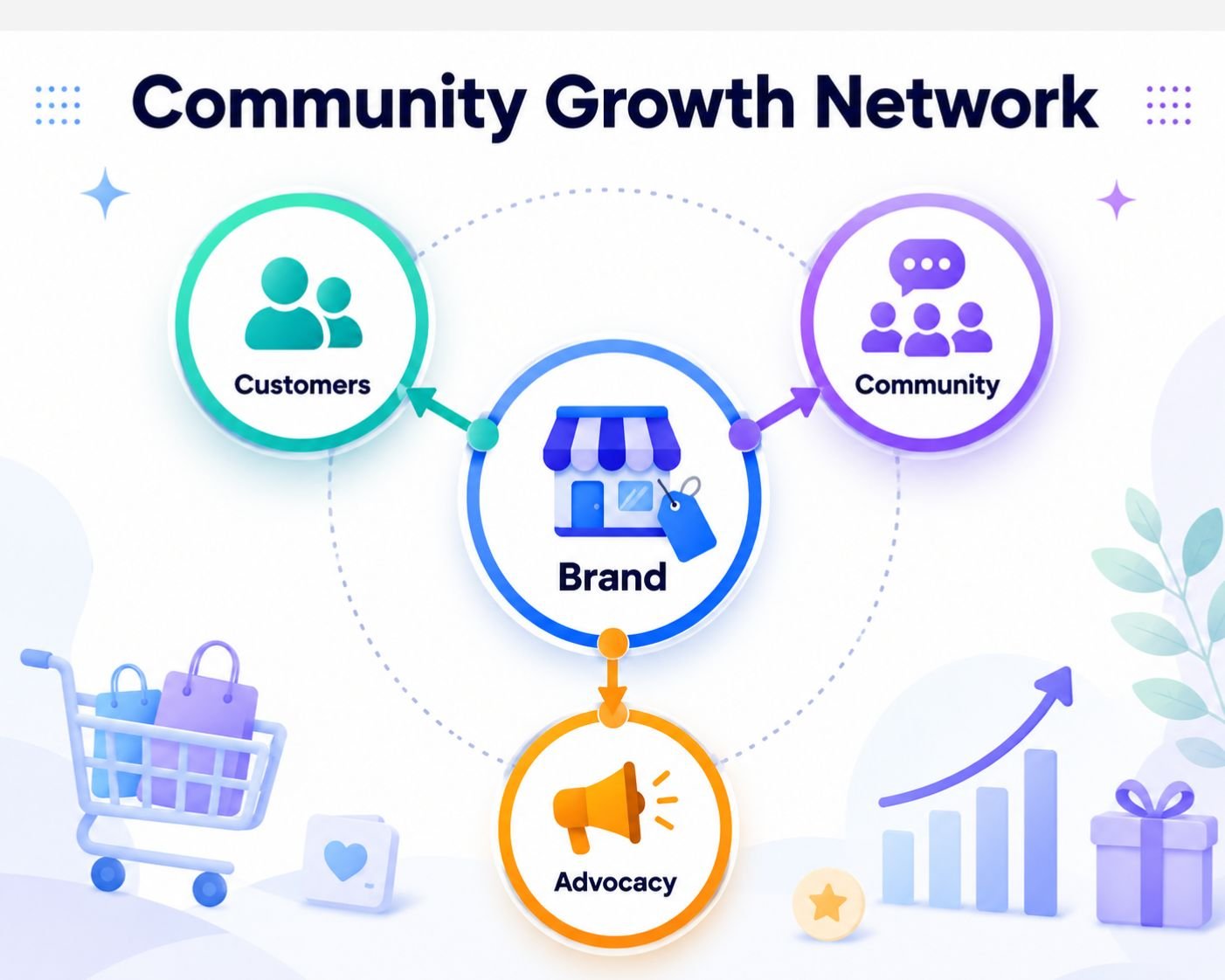
A brand community is a group of customers, followers, and supporters who share a connection with a brand and often interact with one another around common interests, experiences, or goals.
Unlike traditional customer relationships, a community creates engagement beyond individual purchases.
Imagine a fitness apparel brand.
Customers don’t simply buy workout clothes.
They also share fitness goals, workout tips, progress updates, and personal achievements.
Over time, those interactions create connections between customers as well as between customers and the brand.
That’s what transforms a customer base into a community.
A brand community can exist in many forms.
It may be:
- A Facebook group
- An online forum
- A social media audience
- A private membership group
- A customer club
- A brand-owned platform
The specific format matters less than the purpose.
The goal is to create a space where people feel connected through shared interests and experiences.
Strong communities help customers feel like they’re part of something larger than a transaction.
6.2 Community Benefits
Why do successful ecommerce brands invest so much effort into building communities?
Because communities create value that extends far beyond sales.
Imagine a customer who buys from your store once.
Now imagine a customer who regularly interacts with your brand, participates in discussions, shares content, and recommends your products to others.
The second customer contributes significantly more value over time.
This is one of the biggest benefits of community building.
Strong communities often lead to:
- Increased customer loyalty
- Higher customer retention
- More referrals
- Greater engagement
- Stronger trust
- More user-generated content
Communities also create emotional connections.
Customers begin associating positive experiences not only with the products but with the people and conversations surrounding the brand.
For example, a coffee brand might create a community where customers discuss brewing methods, favorite beans, and home coffee setups.
The brand becomes part of a larger experience rather than simply a place to buy coffee.
This deeper connection helps strengthen long-term loyalty and brand growth.
6.3 Community Building Channels
One of the biggest misconceptions about brand communities is that they require complicated technology.
In reality, communities can be built almost anywhere customers naturally gather.
The key is choosing channels that align with your audience.
For example, many ecommerce brands successfully build communities through:
- Facebook groups
- Instagram communities
- Discord servers
- Online forums
- Email newsletters
- Membership platforms
- Private customer groups
Imagine an ecommerce skincare brand.
A Facebook group may allow customers to share skincare routines, ask questions, and discuss products.
A fitness brand may prefer Discord because its audience enjoys real-time conversations.
A business-focused brand may find LinkedIn communities more effective.
The platform itself is not the most important factor.
What matters is creating meaningful opportunities for interaction.
Successful communities focus on conversations rather than constant promotions.
People join communities to connect, learn, and participate—not to be sold to every day.
6.4 Encouraging Customer Participation
Building a community is one thing.
Keeping it active is another.
Many ecommerce brands create groups or communities only to discover that very few people participate.
The reason is simple.
Communities thrive when people have reasons to engage.
Imagine joining a community where nothing happens.
No discussions.
No questions.
No valuable content.
Most members will eventually leave or stop paying attention.
Now imagine a community that regularly shares useful insights, celebrates customer successes, encourages discussions, and invites participation.
Engagement naturally increases.
Successful ecommerce brands encourage participation by:
- Asking questions
- Starting conversations
- Sharing customer stories
- Highlighting user-generated content
- Hosting challenges or events
- Encouraging feedback
For example, a fitness brand might invite customers to share workout milestones.
A home décor brand may encourage customers to post photos of how they’ve styled products in their homes.
These activities create interaction while strengthening customer relationships.
Most importantly, participation helps customers feel seen and valued.
When people feel their contributions matter, they’re more likely to stay engaged with the community and the brand behind it.
Ultimately, brand communities transform ecommerce businesses from product providers into relationship builders.
They create spaces where customers can connect, share experiences, and develop stronger emotional connections with a brand.
By building communities, encouraging participation, and creating meaningful interactions, ecommerce businesses can strengthen loyalty, increase advocacy, and create a powerful foundation for long-term brand growth.
Section 7: Creating Brand Advocates
Imagine a customer purchases a product from your ecommerce store.
They enjoy the experience.
The product meets expectations.
Customer service is helpful.
Everything goes well.
That’s a good outcome.
Now imagine something even better.
The customer tells their friends about the brand.
Shares their experience on social media.
Leaves a positive review.
Recommends your products whenever someone asks for suggestions.
At that point, they’re no longer just a customer.
They’ve become an advocate.
This is one of the most valuable stages of ecommerce brand growth.
Many businesses focus heavily on attracting new customers, but the strongest brands understand that some of their best marketing comes from existing customers. When people genuinely love a brand, they often promote it voluntarily.
And because recommendations come from real people rather than advertisements, they carry a level of trust that traditional marketing often cannot match.
That’s why creating brand advocates is such an important part of long-term brand building.

7.1 What Is Brand Advocacy?
Brand advocacy occurs when customers actively support and promote a brand because of their positive experiences with it.
Unlike paid promotions or advertising campaigns, advocacy is driven by genuine enthusiasm.
Imagine asking a friend for a recommendation.
Perhaps you’re looking for a new coffee brand, skincare product, or fitness accessory.
If a friend enthusiastically recommends a specific company, you’re likely to pay attention.
Why?
Because you trust the person making the recommendation.
This is the foundation of brand advocacy.
Customers become advocates when they feel confident enough to put their own reputation behind a recommendation.
They aren’t promoting the brand because they’re being forced to.
They’re promoting it because they genuinely believe others will benefit from the experience.
Advocacy can take many forms, including:
- Referrals
- Reviews
- Testimonials
- Social media mentions
- Community participation
- User-generated content
The stronger the customer experience, the more likely advocacy becomes.
In many ways, advocacy is one of the clearest signs that a brand has successfully earned customer trust and loyalty.
7.2 Turning Customers Into Advocates
Brand advocates don’t appear by accident.
They are usually created through consistent positive experiences.
Think about the brands you personally recommend.
Chances are, those recommendations are based on more than product quality alone.
Perhaps the company provides excellent service.
Maybe the experience is consistently reliable.
Or perhaps the brand aligns with your values.
These factors contribute to advocacy.
Imagine purchasing from a brand repeatedly over several years.
Every order arrives on time.
The products consistently perform well.
Customer support is responsive.
The company communicates clearly.
Eventually, recommending the brand feels natural.
This is how advocacy develops.
Successful ecommerce brands encourage advocacy by focusing on:
- Exceptional customer experiences
- Consistent quality
- Strong customer relationships
- Community engagement
- Customer appreciation
Many businesses make the mistake of chasing advocacy before earning it.
The reality is simple:
Customers become advocates when they believe the brand deserves it.
The best way to create advocates is to consistently exceed expectations.
7.3 Referral Marketing
One of the most effective ways to encourage advocacy is through referral marketing.
Referral marketing creates opportunities for customers to share brands with others.
Imagine a customer having a positive experience with your business.
A referral program provides an easy way for them to introduce friends and family to the brand.
For example, an ecommerce store might offer:
- Discount credits
- Reward points
- Exclusive perks
- Store vouchers
- Early access opportunities
These incentives can encourage sharing, but the referral itself is usually driven by trust.
People rarely recommend products they don’t genuinely believe in.
This is why referral marketing works best when built on strong customer experiences.
A referral program cannot fix a weak brand.
However, it can amplify a strong one.
The combination of trust and incentives often creates a powerful growth engine.
New customers arrive through recommendations.
Satisfied customers receive rewards.
The brand gains credibility because the introduction comes from someone the prospect already trusts.
7.4 User-Generated Content
Another powerful form of brand advocacy is user-generated content, often called UGC.
User-generated content includes photos, videos, reviews, social media posts, and other content created by customers.
Why is UGC so valuable?
Because it provides authentic proof that real people use and enjoy your products.
Imagine shopping for home décor online.
You see professional product photos from the brand.
They look great.
But then you see customer photos showing how the products look inside real homes.
Suddenly, the brand feels more credible.
The products feel more realistic.
That’s the power of user-generated content.
UGC helps customers answer questions such as:
- What does the product look like in real life?
- How are people actually using it?
- Are customers genuinely satisfied?
It also creates a cycle of advocacy.
One customer shares their experience.
That content influences new customers.
Some of those customers eventually create content of their own.
As the cycle continues, brand visibility and trust continue growing.
This is one reason many successful ecommerce brands actively encourage customers to share photos, reviews, videos, and experiences after purchasing.
Ultimately, brand advocates are among the most valuable assets an ecommerce business can have. They help increase awareness, strengthen credibility, and attract new customers through trusted recommendations.
By creating exceptional customer experiences, encouraging referrals, and promoting user-generated content, ecommerce brands can transform loyal customers into passionate advocates who help fuel long-term growth.
Section 8: Maintaining Brand Consistency at Scale
Building a strong ecommerce brand is challenging.
Maintaining that brand as the business grows can be even more difficult.
Imagine a small ecommerce business in its early days.
The founder writes product descriptions.
Answers customer emails.
Creates social media content.
Makes most branding decisions personally.
As a result, the brand feels consistent because one person oversees everything.
Now imagine the same business three years later.
The team has expanded.
New employees have joined.
Multiple people manage customer support, marketing, social media, and content creation.
The brand is growing.
But a new challenge appears.
How do you maintain consistency as the business scales?
This is one of the most important questions in ecommerce brand building.
Many brands grow successfully at first but gradually lose the qualities that made customers trust and recognize them in the beginning. Messaging becomes inconsistent. Customer experiences vary. Visual identity starts to drift.
Over time, the brand becomes less recognizable and less memorable.
That’s why maintaining consistency at scale is critical for long-term growth.

8.1 Why Consistency Matters
Imagine meeting someone who behaves completely differently every time you interact with them.
One day they’re friendly.
The next day they’re distant.
The day after that they’re unrecognizable.
Over time, it becomes difficult to know what to expect.
The same principle applies to brands.
Customers trust consistency.
They want predictable experiences.
They want confidence that the quality, service, messaging, and overall experience will remain reliable.
For example, imagine ordering from an ecommerce brand multiple times.
Each purchase arrives on schedule.
Product quality remains consistent.
Customer service is helpful.
Communication feels familiar.
Every positive experience reinforces trust.
Now imagine the opposite.
Product quality changes frequently.
Messaging feels different across channels.
Customer service varies from one interaction to another.
Trust becomes harder to maintain.
Consistency matters because it creates reliability.
And reliability strengthens brand equity, customer loyalty, and long-term growth.
The stronger the consistency, the stronger the customer confidence.
8.2 Consistency Across Channels
Modern ecommerce brands interact with customers through many different channels.
Customers may encounter a brand through:
- The website
- Social media
- Email marketing
- Advertisements
- Customer support
- Packaging
- Online communities
The challenge is ensuring these experiences feel connected.
Imagine discovering a brand through Instagram.
The tone feels friendly and modern.
Then you visit the website and find a completely different style of communication.
Later, customer support feels inconsistent again.
The experience becomes confusing.
Strong brands create alignment across every touchpoint.
For example:
- Visual identity remains recognizable
- Messaging remains consistent
- Brand values remain clear
- Customer experience remains reliable
This doesn’t mean every channel must look identical.
Social media content naturally differs from customer support conversations.
However, customers should still recognize the same brand personality throughout the experience.
Consistency across channels strengthens recognition and reinforces trust.
8.3 Team Alignment
As ecommerce businesses grow, brand consistency becomes a team effort.
In the beginning, a founder may control most communication.
As the company expands, multiple people contribute to the customer experience.
This creates both opportunities and challenges.
Imagine a growing ecommerce business with:
- Marketing specialists
- Customer support agents
- Content writers
- Designers
- Social media managers
Each person influences how customers experience the brand.
Without alignment, inconsistencies begin appearing.
One team communicates formally.
Another communicates casually.
One department emphasizes certain values.
Another highlights completely different priorities.
Customers notice these differences.
This is why team alignment is essential.
Everyone involved in the business should understand:
- Brand values
- Brand personality
- Customer expectations
- Communication standards
The goal isn’t to make everyone identical.
The goal is to ensure everyone contributes to a consistent customer experience.
When teams work from the same brand foundation, growth becomes easier to manage.
8.4 Brand Guidelines
One of the most effective tools for maintaining consistency is a brand guideline document.
Think of brand guidelines as a roadmap.
They help everyone understand how the brand should look, sound, and behave.
Imagine hiring a new content writer or social media manager.
Without guidance, they may interpret the brand differently.
With clear guidelines, they can quickly understand the standards they should follow.
Strong brand guidelines often include:
- Logo usage rules
- Color palettes
- Typography standards
- Brand voice guidelines
- Messaging principles
- Visual design standards
These guidelines help reduce confusion and maintain consistency as teams expand.
They also make it easier to work with agencies, freelancers, and external partners.
Most importantly, guidelines protect the brand as it grows.
They ensure that customers continue experiencing the same recognizable identity across every interaction.
8.5 Scaling Without Losing Identity
Growth is exciting.
More customers.
More employees.
More opportunities.
But growth can sometimes create pressure to change too much, too quickly.
Imagine an ecommerce brand that suddenly expands into new markets.
The company introduces new products, launches new campaigns, and hires additional team members.
While growth is positive, the brand begins drifting away from the qualities customers originally loved.
The personality changes.
The messaging becomes inconsistent.
The customer experience feels less personal.
This is a common challenge.
Successful ecommerce brands understand that scaling doesn’t require abandoning their identity.
In fact, growth often makes identity even more important.
The goal is to evolve while remaining recognizable.
Strong brands continue refining and improving their approach, but they stay connected to their core values, personality, and customer promises.
This balance allows them to grow without losing the trust and loyalty they’ve worked so hard to build.
Ultimately, brand consistency is what turns growth into sustainable growth. As ecommerce businesses expand, maintaining alignment across channels, teams, and customer experiences becomes increasingly important.
By creating strong guidelines, keeping teams aligned, and protecting the core identity of the brand, businesses can scale successfully while remaining recognizable, trustworthy, and memorable to customers.
Section 9: Common Ecommerce Brand Growth Mistakes
Building a successful ecommerce brand takes time.
It requires trust, consistency, customer loyalty, and a long-term vision.
Unfortunately, many businesses undermine their own growth without realizing it.
The reason is simple.
As brands begin growing, it’s easy to become distracted by short-term opportunities. Sales targets, advertising metrics, and expansion plans often receive immediate attention, while long-term brand building gets pushed aside.
At first, the impact may not be obvious.
Sales continue.
Traffic increases.
Revenue grows.
But over time, small mistakes begin creating larger problems.
Customer loyalty weakens.
Brand recognition becomes inconsistent.
Growth becomes harder to sustain.
The good news is that many of these mistakes are avoidable.
Let’s explore some of the most common ecommerce brand growth mistakes and how they can affect long-term success.

Mistake 1: Chasing Short-Term Sales
Sales are important.
Every ecommerce business needs revenue to survive and grow.
The problem occurs when short-term sales become the only priority.
Imagine an ecommerce brand running discounts almost every week.
Every campaign produces a temporary increase in sales.
The results look encouraging.
Over time, however, customers begin expecting discounts before making purchases.
The brand becomes associated with promotions rather than value.
As a result, profitability suffers and long-term brand strength weakens.
This is a common mistake.
Businesses become so focused on immediate revenue that they neglect activities that build lasting value.
Strong ecommerce brands understand that sales and brand building must work together.
Promotions can support growth.
But they shouldn’t replace long-term strategies such as customer loyalty, community building, customer experience, and brand awareness.
Short-term sales generate revenue today.
Brand building creates growth for tomorrow.
The most successful ecommerce businesses invest in both.
Mistake 2: Ignoring Existing Customers
Many brands spend enormous amounts of money acquiring new customers while paying very little attention to existing ones.
This can be a costly mistake.
Imagine spending $20 to acquire a customer through advertising.
The customer makes a purchase.
Then the business never communicates with them again.
No follow-up.
No recommendations.
No loyalty incentives.
No effort to strengthen the relationship.
Eventually, the customer forgets the brand.
Now the business must spend another $20 acquiring someone new.
This cycle can become expensive very quickly.
Existing customers are often one of the most valuable growth opportunities a business has.
They already know the brand.
They’ve already trusted the business enough to make a purchase.
In many cases, retaining an existing customer is easier than acquiring a new one.
This is why successful ecommerce brands invest heavily in:
- Customer retention
- Loyalty programs
- Email marketing
- Personalized experiences
- Post-purchase engagement
Growth becomes much more sustainable when businesses focus on both acquisition and retention.
Mistake 3: Inconsistent Branding
Imagine following a brand on social media.
The content feels modern and professional.
Then you visit the website and encounter a completely different visual style.
Customer emails sound different again.
Support interactions feel disconnected from everything else.
The experience becomes confusing.
This is what happens when branding lacks consistency.
As businesses grow, maintaining consistency becomes increasingly important.
Customers should be able to recognize the brand regardless of where they encounter it.
This includes:
- Visual identity
- Brand voice
- Messaging
- Customer experience
- Brand values
Inconsistent branding creates uncertainty.
And uncertainty weakens trust.
Strong ecommerce brands work hard to maintain alignment across every customer touchpoint.
The result is greater recognition, stronger trust, and a more memorable brand experience.
Mistake 4: Expanding Too Quickly
Growth is exciting.
When sales increase and opportunities appear, expansion often feels like the natural next step.
However, rapid expansion can sometimes create problems.
Imagine an ecommerce business that suddenly launches multiple product lines, enters new markets, and expands its operations all at once.
The ambition is impressive.
But resources become stretched.
Quality control declines.
Customer support struggles to keep up.
Brand consistency becomes harder to maintain.
Eventually, customers begin noticing the decline in experience.
This is why sustainable growth often outperforms aggressive growth.
Successful ecommerce brands expand strategically.
They ensure systems, processes, and customer experiences remain strong before taking on additional complexity.
Growth should strengthen the brand, not weaken it.
Moving too quickly can sometimes create more problems than opportunities.
Mistake 5: Neglecting Customer Experience
Perhaps the most damaging brand growth mistake is neglecting customer experience.
Many businesses focus heavily on attracting customers but pay less attention to what happens after the purchase.
Imagine a customer who loves your marketing.
The website looks great.
The product appears promising.
They place an order.
Then the experience falls apart.
Shipping is delayed.
Support is unresponsive.
Product quality disappoints.
The customer leaves frustrated.
All the marketing in the world cannot compensate for a poor customer experience.
In fact, customer experience is often what determines whether growth becomes sustainable.
Positive experiences create:
- Repeat purchases
- Customer loyalty
- Referrals
- Positive reviews
- Brand advocacy
Negative experiences create the opposite.
This is why customer experience should remain a priority at every stage of growth.
The strongest ecommerce brands understand that every interaction contributes to how customers perceive the business.
Growth doesn’t come from attracting customers once.
It comes from creating experiences that make them want to return.
Ultimately, ecommerce brand growth is not just about increasing sales or expanding operations. It’s about building a business that customers continue trusting and supporting over time.
By avoiding short-term thinking, investing in existing customers, maintaining consistency, expanding strategically, and prioritizing customer experience, ecommerce brands can create stronger foundations for sustainable growth and long-term success.
Section 10: Ecommerce Brand Growth Framework
Throughout this guide, we’ve explored the key elements that contribute to long-term ecommerce brand growth.
We’ve discussed brand awareness, brand equity, customer loyalty, community building, advocacy, consistency, and sustainable growth strategies.
The challenge now is bringing all of those pieces together.
Many ecommerce business owners understand the individual concepts, but they often struggle with implementation.
They ask questions like:
- Where should I start?
- What should I focus on first?
- How do these pieces connect?
- What does a practical brand growth strategy actually look like?
The answer is that brand growth doesn’t happen through a single campaign, tactic, or promotion.
It happens through a system.
A system that gradually transforms strangers into customers, customers into loyal supporters, and loyal supporters into brand advocates.
The framework below provides a simple roadmap for building sustainable ecommerce brand growth.

Step 1 — Build Awareness
Before customers can trust your brand, they must know it exists.
This is where every ecommerce growth journey begins.
Imagine launching an amazing ecommerce store with exceptional products and outstanding customer service.
None of those strengths matter if potential customers never discover the business.
Awareness creates opportunities.
It introduces people to your brand and starts the customer journey.
Successful awareness-building activities often include:
- Search engine optimization (SEO)
- Content marketing
- Social media marketing
- Paid advertising
- Strategic partnerships
For example, a home décor brand may publish helpful blog content, share design inspiration on social media, and run targeted advertising campaigns.
Over time, more people become familiar with the brand.
Awareness doesn’t guarantee sales.
But without awareness, sales become impossible.
Step 2 — Earn Trust
Awareness gets attention.
Trust earns business.
Imagine discovering a brand for the first time.
Before purchasing, you naturally look for reasons to believe the company is reliable.
You read reviews.
Check policies.
Explore product information.
Evaluate the overall experience.
Customers do this every day.
That’s why trust is one of the most important growth assets an ecommerce brand can build.
Trust develops through:
- Transparency
- Reviews
- Testimonials
- Social proof
- Reliable customer service
- Consistent experiences
Think back to the previous blog in this ebook series.
Everything discussed there contributes directly to growth because trust reduces hesitation and increases customer confidence.
Without trust, awareness rarely turns into long-term success.
Step 3 — Improve Customer Experience
Many businesses focus heavily on acquiring customers.
The strongest brands focus equally on serving them.
Imagine two ecommerce stores selling similar products.
One creates a smooth, enjoyable experience.
The other creates frustration at every stage.
Which brand is more likely to earn repeat purchases?
Customer experience influences almost every aspect of growth.
It affects:
- Customer satisfaction
- Retention
- Reviews
- Referrals
- Loyalty
Improving customer experience may involve:
- Simplifying website navigation
- Streamlining checkout
- Improving customer support
- Enhancing delivery processes
- Strengthening product quality
Every positive interaction strengthens customer perception of the brand.
And stronger perceptions create stronger growth opportunities.
Step 4 — Strengthen Loyalty
The next stage of growth focuses on retention.
Imagine acquiring a customer once and never seeing them again.
Now imagine that same customer returning five or six times over the next few years.
The difference in value is substantial.
This is why customer loyalty is such a powerful growth driver.
Loyal customers:
- Buy more frequently
- Spend more over time
- Trust the brand more deeply
- Recommend products to others
Brands strengthen loyalty through:
- Consistent customer experiences
- Loyalty programs
- Personalized communication
- Excellent customer support
- Relevant recommendations
When loyalty increases, growth becomes more predictable and sustainable.
The business relies less on constantly finding new customers and more on strengthening existing relationships.
Step 5 — Encourage Advocacy
One of the most exciting stages of brand growth occurs when customers begin promoting the brand themselves.
At this point, customers become advocates.
Imagine a customer sharing your products on social media.
Writing positive reviews.
Referring friends.
Recommending your brand whenever someone asks for advice.
This type of advocacy is incredibly valuable because people trust recommendations from other people.
Advocacy often grows through:
- Exceptional experiences
- Referral programs
- Community engagement
- User-generated content
- Customer appreciation
Advocates help expand awareness while simultaneously increasing trust.
In many cases, they become one of the most effective marketing channels available to a brand.
Step 6 — Scale Consistently
Growth creates opportunities.
It also creates challenges.
As ecommerce brands expand, maintaining consistency becomes increasingly important.
Imagine a business doubling in size.
More employees join.
More customers arrive.
More channels are added.
Without consistency, the customer experience can quickly become fragmented.
This is why successful brands focus on scaling carefully.
They protect the qualities that made customers trust the business in the first place.
Consistency should remain strong across:
- Branding
- Messaging
- Customer service
- Product quality
- Customer experiences
The goal isn’t simply to become bigger.
The goal is to become bigger without losing the brand’s identity.
This is what separates sustainable growth from temporary growth.
Ultimately, ecommerce brand growth is a journey rather than a single achievement. It begins with awareness, develops through trust, strengthens through customer experience and loyalty, expands through advocacy, and succeeds through consistency.
By following this framework, ecommerce businesses can create a growth system that not only attracts customers but also retains them, delights them, and transforms them into long-term supporters of the brand.
Section 11: Ecommerce Brand Growth Checklist
Building a successful ecommerce brand doesn’t happen through a single campaign or marketing tactic.
Long-term growth is the result of consistent effort across multiple areas of the business. Brand awareness, customer loyalty, community building, customer experience, and advocacy all work together to create sustainable growth.
Use the checklist below to evaluate your current brand growth strategy and identify opportunities for improvement.
The more boxes you can confidently check, the stronger your foundation for long-term ecommerce growth.

Brand Awareness
☐ Brand awareness strategy is documented
☐ Organic traffic growth initiatives are active
☐ Content marketing efforts support brand visibility
☐ Social media visibility is consistently maintained
☐ Brand awareness metrics are regularly monitored
Customer Retention and Loyalty
☐ Customer retention strategy is established
☐ Loyalty program is implemented
☐ Repeat purchase campaigns are active
☐ Customer relationships are nurtured beyond the first sale
☐ Existing customers receive ongoing value and support
Community and Advocacy
☐ Community building efforts are active
☐ Customers are encouraged to participate and engage
☐ Referral strategy is created and promoted
☐ Advocacy opportunities are available for loyal customers
☐ User-generated content is actively encouraged
Brand Consistency
☐ Brand guidelines are documented
☐ Visual identity remains consistent across channels
☐ Brand messaging remains aligned across touchpoints
☐ Team members understand brand standards
☐ Brand consistency is maintained as the business grows
Long-Term Growth Planning
☐ Customer experience is continuously monitored
☐ Customer feedback is collected and reviewed
☐ Brand equity is actively strengthened
☐ Long-term growth goals are clearly defined
☐ Growth decisions align with long-term brand strategy
Quick Self-Assessment
18–25 boxes checked
Excellent. Your ecommerce brand has a strong growth foundation and is positioned for sustainable long-term success.
12–17 boxes checked
Good progress. Several important growth systems are in place, but there are still opportunities to strengthen your brand-building efforts.
6–11 boxes checked
Your growth strategy is developing, but there are significant areas that need attention before sustainable growth can be achieved.
0–5 boxes checked
Start with the Ecommerce Brand Growth Framework from the previous section and focus on building the fundamentals before scaling aggressively.
Remember, strong ecommerce brands are not built through isolated marketing campaigns. They grow because awareness, trust, loyalty, advocacy, consistency, and customer experience work together over time.
The stronger these foundations become, the easier it becomes to achieve sustainable growth year after year.
Conclusion
Building a successful ecommerce brand takes time.
It does not come from one campaign, one promotion, or a few quick sales. Long-term growth comes from consistently creating positive customer experiences and giving people a reason to trust your business.
Strong ecommerce brand building focuses on more than visibility. It strengthens brand awareness, customer loyalty, brand equity, advocacy, and consistency over time.
Every repeat purchase, positive review, referral, and customer interaction adds value to your brand.
And as trust grows, growth often becomes easier and more sustainable.
The goal is not simply to attract more customers.
It is to build a brand people remember, choose, and recommend.
Because products can generate sales.
But a strong ecommerce brand creates lasting growth.
Ready to Build a Stronger Ecommerce Brand?
You’ve now learned how to build a brand foundation, create a strong identity, earn customer trust, and drive long-term growth.
But the real power of ecommerce branding comes from bringing all of these elements together into a single, cohesive system.
Successful ecommerce brands don’t rely on isolated tactics. They combine strategy, identity, trust, customer experience, loyalty, and consistency to create brands that customers recognize, trust, and support for years.
That’s exactly what the Ecommerce Branding Ebook is designed to help you do.
Inside, you’ll learn how to:
✔ Build a strong brand foundation from the ground up
✔ Create a memorable and recognizable brand identity
✔ Earn customer trust and strengthen credibility
✔ Increase customer loyalty and advocacy
✔ Build long-term brand equity
✔ Create sustainable growth systems that support ongoing success
Whether you’re launching a new ecommerce business or strengthening an existing one, the goal remains the same: build a brand that continues creating value long after the first sale.
You’ve now learned how to build a brand foundation, create a strong identity, earn customer trust, and drive long-term growth. The next step is bringing these strategies together into a complete ecommerce branding system that supports sustainable business success.