

What if you spend months learning a freelance skill—only to discover you don’t know what service to offer or why a client would pay for it?
Maybe you’re torn between writing, design, marketing, coding, and AI tools. One article calls a skill “high-paying”; another says it’s easy to learn. Yet what does the work actually involve?
The best freelance skills to learn in 2027 aren’t simply the ones making headlines. They’re skills you can develop well enough to solve a real problem for a client.
Knowing how to use a design tool, for example, isn’t the same as creating a polished campaign graphic someone can confidently publish.
In this guide, you’ll explore 15 in-demand skills, see examples of services clients may purchase, discover realistic first portfolio projects, and use a simple framework to choose a starting point that fits you.
Which Freelance Skills Are Worth Learning in 2027?
Some of the best freelance skills to learn in 2027 include content writing, search engine optimization (SEO), graphic design, video editing, social media management, WordPress website building, virtual assistance, data analysis, web development, and AI workflow integration.
Each can become a service that helps a client solve a specific problem.
But a popular skill isn’t automatically the right starting point. Writing and editing require research and clear communication; web development demands stronger technical foundations; and even basic virtual assistance depends on organization, accuracy, and trust.
You might enjoy creating social graphics but dislike analyzing campaign data—or the opposite.
There is real evidence behind these directions. Upwork’s 2026 skills report identified continuing demand for established creative, technical, and support services, alongside growth in AI-related work. Those findings describe past marketplace activity, not confirmed demand or earnings for 2027.
As you explore the 15 options below, look beyond popularity: consider what you can learn, demonstrate in a portfolio, and eventually deliver reliably.
What Makes a Freelance Skill Worth Learning?
Before choosing a freelance skill, ask a more useful question than “Is it popular?” Can I learn it well enough to help a client—and show what I can do?
Five things deserve a closer look:
- Real client demand: Look for services businesses actually request, not just headlines about high salaries. Job posts offer clues, not guarantees.
- Personal suitability: Consider what you enjoy and do well. You’ll spend time practicing, not just watching tutorials.
- Learning requirements: Check the knowledge, software, equipment, and practice needed before investing in a course.
- Proof of ability: Can you create a realistic sample that demonstrates your work without pretending it was a paid project?
- Long-term usefulness: Can the skill grow as client expectations and tools change?
For example, if you enjoy researching and explaining ideas, SEO content writing may suit you better than web development. If you enjoy technical problem-solving, the reverse may be true.
Remember:
High demand can also mean strong competition. A promising skill is one you can realistically learn, practice, and eventually offer with confidence—not simply one advertised as highly paid.
Best Freelance Skills to Learn in 2027: Quick Comparison
Not every freelance skill requires the same starting point. Some let you begin practicing with basic tools, while others demand specialized knowledge, technical experience, or greater responsibility.
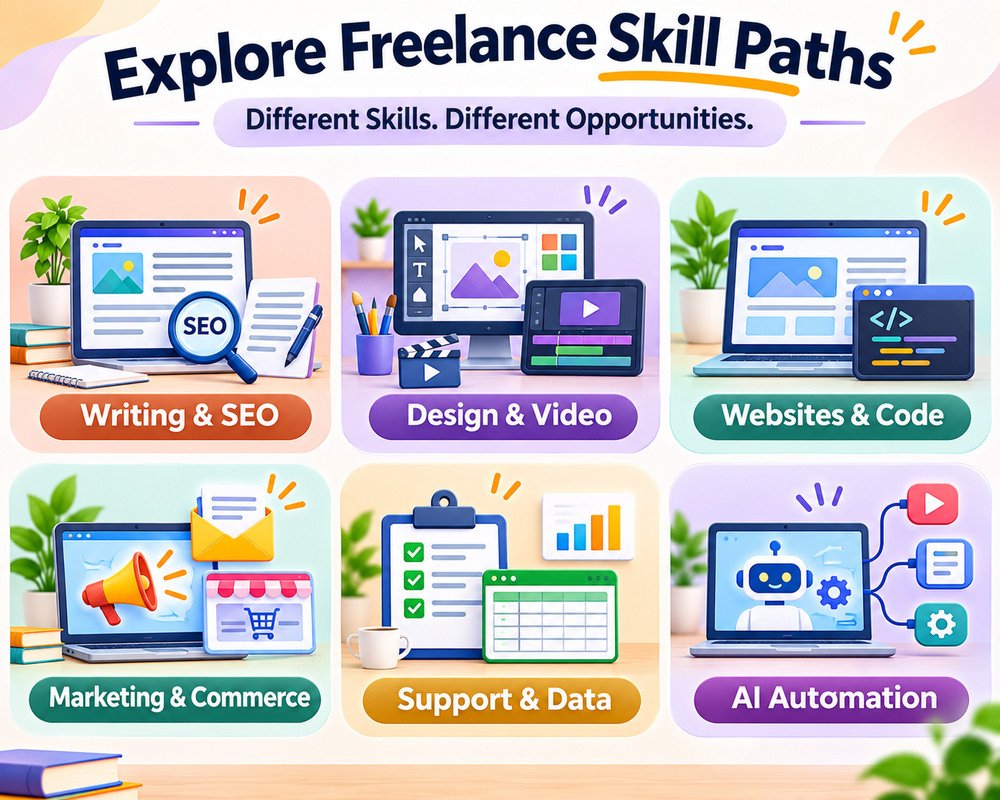
The table below compares 15 freelance skills worth exploring in 2027, showing what clients might hire you to do and how you could begin demonstrating your abilities.
Freelance Skill | Example Client Service | Starting Complexity | First Portfolio Project |
Content Writing & Editing | Blog articles and content updates | More approachable to explore | Write and edit a researched blog article |
SEO | On-page website optimization | Requires substantial practice | Create an SEO audit for a sample webpage |
Copywriting | Landing pages and promotional copy | Requires substantial practice | Write a fictional product landing page |
Social Media Management | Content planning and account support | More approachable to explore | Create a sample one-week social content plan |
Graphic Design | Promotional graphics and brand materials | Requires substantial practice | Design three coordinated promotional graphics |
Video Editing | Short-form videos and promotional clips | Requires substantial practice | Edit a short video using permitted footage |
WordPress & No-Code Websites | Business websites and landing pages | Requires substantial practice | Build a responsive demonstration website |
Virtual Assistance | Administrative and scheduling support | More approachable to explore | Create a sample inbox workflow and task tracker |
Email Marketing | Newsletters and welcome sequences | Requires substantial practice | Write a three-email welcome sequence |
Ecommerce Store Management | Product listings and catalog updates | More approachable to explore | Prepare five optimized sample product listings |
Data Analysis | Spreadsheet reports and dashboards | Requires substantial practice | Build a dashboard using fictional sales data |
Paid Advertising | Campaign setup and management | Requires advanced preparation | Develop a hypothetical advertising campaign plan |
UX/UI Design | Website wireframes and interface design | Requires substantial practice | Design an interactive checkout-page prototype |
Web Development & Coding | Custom websites and web features | Requires advanced preparation | Build and test a small interactive web feature |
AI Workflow Automation | Business process automation and integrations | Requires advanced preparation | Create a workflow using fictional customer inquiries |
How to interpret starting complexity: These labels describe the relative preparation involved, not how easily you can find clients. A skill that’s approachable to explore may still take considerable practice to deliver professionally. More technical or financially sensitive work may require advanced preparation.
These are DGF editorial assessments, not scientifically verified difficulty rankings or predictions of income.
Each portfolio idea represents a practice project, not completed client work. Clearly identify fictional projects and use appropriately licensed materials.
Your next step:
Shortlist two or three skills that match your interests and resources. Then explore what the work involves before investing heavily in courses or software.
15 In-Demand Freelance Skills You Can Sell Online
Knowing a skill is one thing. Knowing how to use it to solve a client’s problem is what makes it marketable.
For example, a business owner doesn’t necessarily need someone who “knows Canva.” They may need attractive promotional graphics that communicate an offer clearly. Similarly, knowing WordPress is different from building a functional website for a client.
Let’s explore 15 freelance skills, the services you could develop, and realistic projects that help demonstrate your abilities.
These skills aren’t ranked by earnings or difficulty. Each offers different opportunities, learning requirements, and challenges.
Content Writing and Editing
Imagine a small business owner who understands their products but struggles to explain them clearly online. They might need someone to turn their knowledge into helpful articles, engaging website pages, or accurate product descriptions.
That’s where content writers and editors come in.
Content writing combines research, clear communication, organization, and fact-checking. Editing improves existing material by correcting errors, removing unnecessary information, and making the message easier to understand.
- What clients may hire you for: Blog writing, website content, article updates, product descriptions, and editing.
- Your first portfolio challenge: Write a helpful article about a topic you understand. Research it carefully, use reliable sources, and include a short before-and-after editing example to demonstrate how you improved the draft.
- What should you learn first? Research techniques, article structure, grammar, audience awareness, and responsible AI use.
This skill may suit you if you enjoy reading, researching, explaining ideas, and improving written work. AI tools can assist, but a professional writer remains responsible for the finished content’s accuracy and originality.
Search Engine Optimization (SEO)
Have you ever searched for a service online and wondered why some websites appear more prominently than others?
SEO helps website owners improve how their content and pages are discovered and understood by search engines.
A freelancer might examine a website’s headings, content structure, internal links, search intent, or technical problems. The goal is to make useful information accessible to the people searching for it.
What clients may hire you for: On-page optimization, keyword research, content audits, local SEO support, and website improvements.
Your first portfolio challenge: Choose a practice website or a page you own. Create a simple SEO audit identifying problems, recommended improvements, and the reasons behind your suggestions.
You can begin learning through Google’s SEO Starter Guide.
What should you learn first? Search intent, crawling and indexing, content quality, technical basics, and performance measurement.
SEO may suit people who enjoy research, analysis, writing, and problem-solving. Remember, good SEO work cannot guarantee rankings, and a portfolio audit shouldn’t claim improvements you haven’t measured.
Copywriting
Consider two product descriptions.
One simply lists a notebook’s size, color, and number of pages. The other explains how its layout helps someone organize daily tasks, while still providing accurate product details.
The second approach demonstrates what copywriting tries to achieve: helping people understand an offer and decide what to do next.
Copywriters create messages that support actions such as requesting a quote, signing up for a newsletter, or considering a purchase.
What clients may hire you for: Landing pages, promotional emails, product descriptions, website sales copy, and advertisements.
Your first portfolio challenge: Choose a fictional product and write a landing page with a headline, benefits, product information, frequently asked questions, and an appropriate call to action. Explain why you selected each message.
What should you learn first? Customer research, persuasive writing, offer positioning, clear calls to action, and ethical marketing.
Copywriting may suit you if you enjoy understanding people’s decisions and finding compelling ways to communicate ideas. Strong copy is persuasive without inventing benefits or making misleading promises.
Social Media Marketing and Management
A restaurant, clothing store, or fitness studio may have great products but little time to maintain its social media presence.
A social media freelancer can help organize what the business shares, why it matters, and how it reaches the intended audience.
However, social media management involves more than posting attractive pictures. It can include content planning, caption writing, scheduling, audience interaction, and performance reviews.
- What clients may hire you for: Social media content plans, post creation, scheduling, community support, and basic reporting.
- Your first portfolio challenge: Create a one-week social media plan for a fictional small business. Include post ideas, sample captions, recommended formats, and a short explanation of each post’s purpose.
- For example, a fitness studio might use separate posts to explain its classes, answer membership questions, and share verified schedule information.
- What should you learn first?
- Audience research, platform features, content planning, community communication, and basic analytics.
This skill may suit creative, organized people who enjoy communication and following digital trends—but successful planning requires knowing which trends actually matter to a business.
Graphic Design
Picture a café preparing to introduce a seasonal menu.
It needs a poster for its storefront, an Instagram graphic, and a matching digital advertisement. All three should feel connected, even though their sizes and purposes differ.
A graphic designer creates that visual consistency.
Graphic design uses typography, color, layout, imagery, and composition to communicate ideas effectively. It’s not simply about making something attractive; readers must also understand the message.
- What clients may hire you for: Promotional graphics, social media visuals, presentations, brochures, and brand-supporting materials.
- Your first portfolio challenge: Design three coordinated promotional pieces for a fictional café. Show how you adapted the same message to different formats.
- What should you learn first? Visual hierarchy, typography, color contrast, spacing, accessibility, and design software.
A beginner can explore tools such as Canva or professional design applications, but knowing the software is not the same as understanding design.
This field may suit you if you enjoy visual creativity, careful details, and finding better ways to present information. Use original or properly licensed design materials.
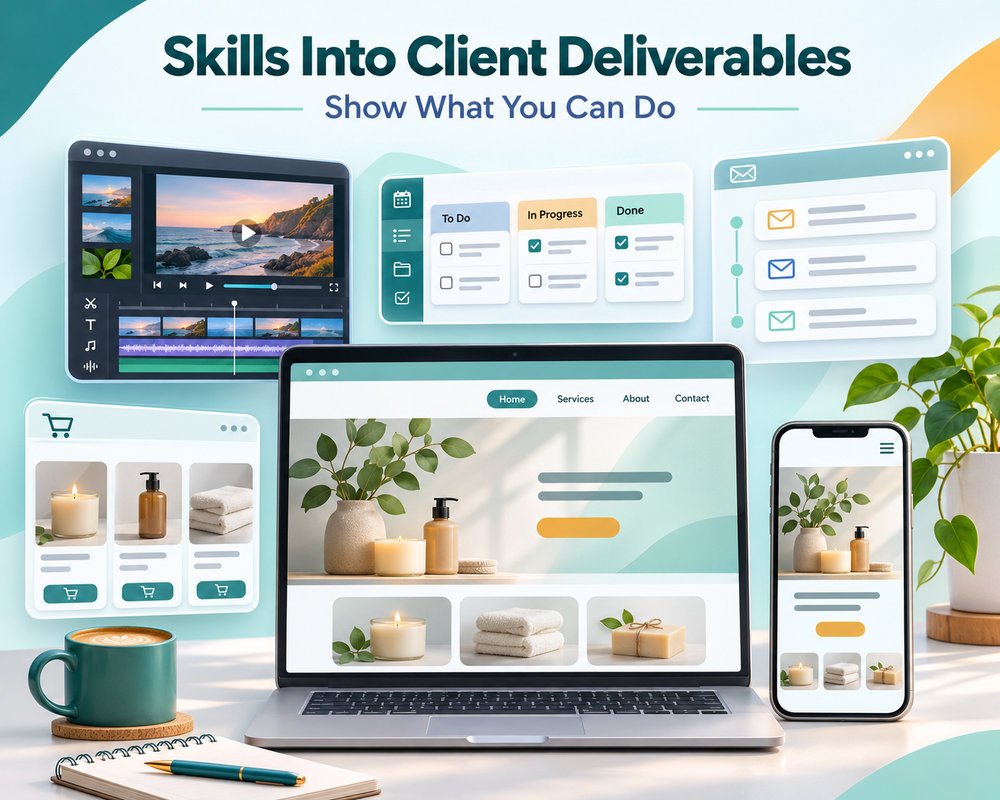
Video Editing
A cooking instructor records a ten-minute demonstration but needs a short video explaining one useful technique.
A video editor could select the relevant footage, remove unnecessary pauses, adjust the audio, add readable captions, and create a clear finished clip.
That is the practical value of video editing: turning raw material into content that serves a specific purpose.
- What clients may hire you for: Short-form videos, YouTube editing, promotional clips, interview highlights, subtitles, and basic post-production.
- Your first portfolio challenge: Record a short educational video or use properly licensed footage. Create a polished edited version and explain how your changes improved clarity or pacing.
- What should you learn first? Editing software, storytelling, transitions, sound, pacing, captions, and export settings.
Video editing may suit people who enjoy visual storytelling, creative decisions, and technical problem-solving.
AI tools can help automate certain editing tasks, but a reliable freelancer still checks the final result. Copyright permissions, accurate captions, and suitable audio remain important.
WordPress and No-Code Website Building
Not every business needs a custom-coded website.
A local tutoring center, for example, might simply need a professional place to explain its services, display relevant information, and allow visitors to make inquiries.
WordPress and visual website builders can help create that experience without requiring advanced programming for every project.
- What clients may hire you for: Business websites, landing pages, page redesigns, content updates, and routine website maintenance.
- Your first portfolio challenge: Build a fictional five-page tutoring website with a home page, about page, services page, FAQs, and contact page. Test how it looks and functions on mobile devices.
- What should you learn first?
- WordPress fundamentals, responsive layouts, navigation, forms, basic accessibility, website performance, security, and handover procedures.
This work may suit people who enjoy combining creativity with technical problem-solving.
A website should do more than look beautiful in a screenshot. Clients need pages that function properly, communicate clearly, and remain manageable after delivery.
Virtual Assistance
Many business owners spend hours handling appointments, documents, email, and routine administrative tasks.
A virtual assistant helps organize some of that work remotely so the owner can focus on other responsibilities.
Depending on the client’s needs, services might involve scheduling meetings, preparing documents, maintaining spreadsheets, organizing research, or handling agreed customer communications.
What clients may hire you for: Calendar management, inbox organization, research assistance, document preparation, and administrative support.
Your first portfolio challenge: Create a fictional appointment-management system with a scheduling tracker, sample customer messages, and a checklist for handling changes.
Show how the workflow keeps information organized and reduces avoidable mistakes.
What should you learn first? Professional communication, common productivity tools, task organization, recordkeeping, and confidentiality.
Virtual assistance may suit dependable people who enjoy planning, organization, and supporting others.
Although some administrative tasks are approachable for beginners, working with real customer information or business accounts requires trust, accuracy, and appropriate safeguards.
Email Marketing
Imagine someone subscribing to a small online bookstore’s newsletter.
They may appreciate a welcome email introducing the store, another explaining its collections, and a later message highlighting relevant reading recommendations.
An email marketing freelancer helps plan and create communications like these.
The work combines writing, audience understanding, campaign organization, and basic performance analysis.
- What clients may hire you for: Newsletter writing, welcome sequences, campaign preparation, email templates, and reporting.
- Your first portfolio challenge: Write a three-email welcome sequence for a fictional online bookstore. Include subject lines, preview text, body copy, and a clear purpose for each message.
- What should you learn first? Email writing, audience segmentation basics, campaign tools, consent requirements, deliverability, and measurement.
This skill may suit writers who enjoy both communication and marketing strategy.
One important distinction: email marketing is not simply sending messages to as many people as possible. Permission, relevance, subscriber expectations, and clear unsubscribe options matter.
Ecommerce Store Management
Think about an online clothing store with hundreds of products.
Every item needs accurate descriptions, suitable images, pricing information, size details, and consistent product categories. Keeping everything organized can become a substantial job.
Ecommerce freelancers may help businesses maintain these details and improve the shopping experience.
- What clients may hire you for: Product listings, catalog management, store content updates, category organization, and routine ecommerce support.
- Your first portfolio challenge: Create five fictional product listings with clear titles, accurate sample attributes, descriptions, image requirements, and consistent formatting.
- What should you learn first? Ecommerce platform basics, product information management, spreadsheet organization, and quality checking.
Explain how your listing structure helps shoppers compare products and find relevant information.
This skill may suit organized people who enjoy retail, product details, and digital store operations.
Accuracy is especially important: never invent product specifications, availability, delivery terms, or customer reviews to make a listing more attractive.
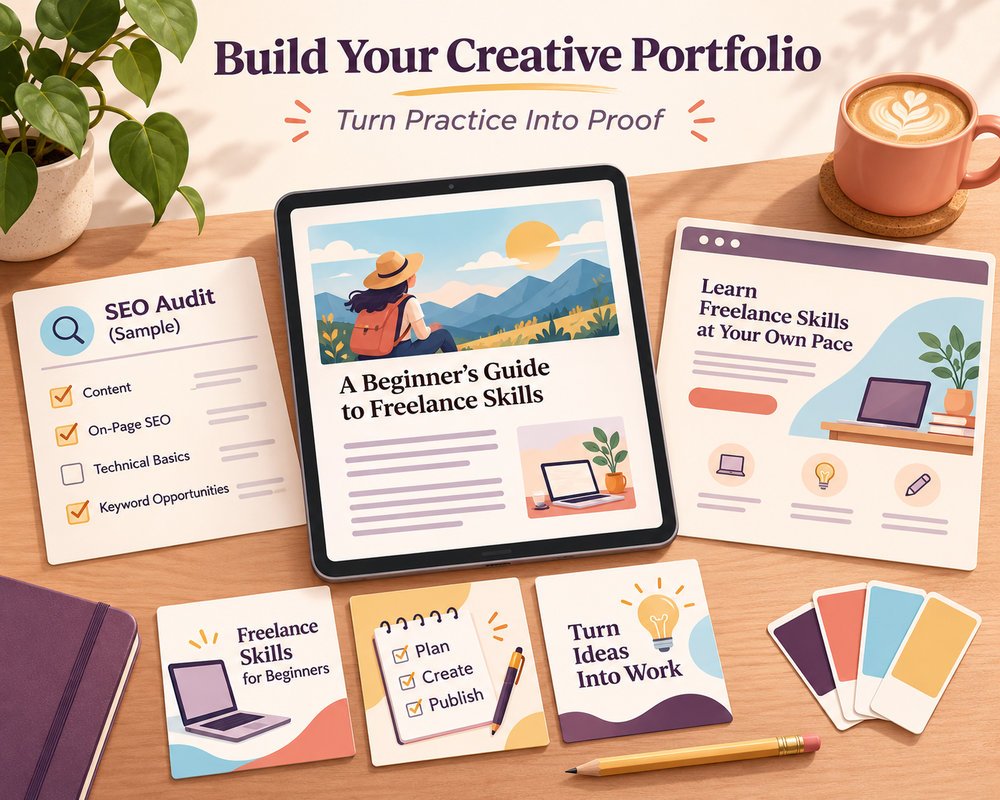
Data Analysis and Spreadsheet Reporting
Suppose a small shop owner has months of sales records but struggles to understand which product categories perform differently.
A data-focused freelancer could clean the spreadsheet, organize the information, and present a simple report that makes patterns easier to see.
Data analysis involves much more than building colorful charts. It requires asking useful questions, checking data quality, and interpreting information carefully.
- What clients may hire you for: Spreadsheet cleaning, dashboard creation, data organization, recurring reports, and basic analysis.
- Your first portfolio challenge: Create a sales dashboard using fictional data. Include a cleaned dataset, useful formulas, a few clear charts, and a short explanation of the findings.
- What should you learn first? Spreadsheet formulas, data validation, descriptive statistics, visualization, and interpretation.
This field may suit people who enjoy numbers, logic, detail, and solving practical questions.
A professional report should also explain what the data cannot prove. A pattern in sales records, for example, doesn’t automatically establish why customers behaved that way.
Paid Advertising
A business may decide to advertise its products online but needs help planning campaigns and managing the spending responsibly.
Paid advertising freelancers can assist with campaign objectives, audiences, advertising messages, account setup, creative testing, and reporting.
For example, a home décor retailer might want to promote a new collection to a relevant audience.
Before launching anything, a responsible freelancer should understand the offer, advertising budget, landing page, tracking requirements, and platform policies.
What clients may hire you for: Campaign planning, account setup, advertisement testing, and performance reviews.
Your first portfolio challenge: Prepare a hypothetical advertising campaign for a fictional retailer. Include the objective, audience assumptions, sample advertisements, budget safeguards, and a measurement plan.
What should you learn first? Advertising platforms, campaign structure, tracking, conversion concepts, and budget management.
This field may suit analytical thinkers who also enjoy marketing creativity.
Important: Managing real advertising budgets creates financial responsibility. Beginners should practice and develop adequate competence before handling client spending, and never guarantee advertising returns.
UX/UI Design
Have you ever visited a website where you couldn’t find the checkout button or understand what information a form required?
Those frustrations are related to user experience.
UX design focuses on how people interact with a product, while UI design addresses the visual and interactive elements they use.
Freelancers may create wireframes, design screens, build prototypes, or improve confusing digital experiences.
- What clients may hire you for: Website interfaces, mobile app designs, prototypes, usability improvements, and navigation redesigns.
- Your first portfolio challenge: Redesign a fictional ecommerce checkout page. Create an initial wireframe, an improved interface, and a short explanation of the problems you intended to solve.
- What should you learn first? User needs, information architecture, interface design, accessibility, prototyping, and usability testing.
This field may suit people who enjoy visual design and understanding how others think.
Remember, a beautiful interface isn’t necessarily a usable one. Good design decisions should consider evidence and testing rather than visual preferences alone.
Web Development and Coding
Sometimes a website needs functionality that goes beyond what a visual page builder can easily provide.
A business might require a custom booking system, an interactive calculator, or a feature that connects different applications.
Web developers create and troubleshoot these solutions through programming.
The field includes front-end development, back-end systems, and full-stack work, each requiring different knowledge.
What clients may hire you for: Custom website features, web applications, technical troubleshooting, integrations, and development support.
Your first portfolio challenge: Build a small interactive registration form that checks user input, displays clear error messages, and works on different screen sizes. Document how you tested it.
What should you learn first? Programming fundamentals, HTML, CSS, JavaScript (where relevant), debugging, version control, security, and testing.
This field may suit people who enjoy technical challenges and persistent problem-solving.
Learning to copy code from a tutorial is different from understanding how to maintain a working application. Professional competence develops through practice and careful testing.
AI Workflow Automation and Integration
Imagine a small service business receiving customer questions through an online form.
Instead of manually copying every message into a tracking spreadsheet, the business might benefit from a workflow that organizes inquiries and flags those needing attention.
AI-assisted automation can support processes like this by connecting applications, processing information, or preparing drafts for human review.
- What clients may hire you for: Workflow automation, software integrations, internal assistants, information organization, and repetitive-process improvements.
- Your first portfolio challenge: Build a demonstration workflow using fictional customer inquiries. Show how each message enters the system, how information is categorized, and how errors or uncertain cases are handled.
- What should you learn first? Workflow logic, software integrations, data handling, authentication, testing, and troubleshooting.
This field may suit technically curious people who enjoy connecting systems and simplifying repetitive tasks.
Important: Writing a clever AI prompt isn’t the same as delivering dependable automation. Clients need secure, accurate, maintainable systems with appropriate human oversight.
The takeaway:
These 15 skills represent different ways to provide value through freelance work—not a ranking of guaranteed income opportunities. As you explore them, pay attention to the type of work you enjoy, the skills you can realistically develop, and the problems you could eventually solve for clients.
Which Freelance Skills Are Easier for Beginners to Explore?
Some freelance skills are easier to start practicing, but that doesn’t make them easy to sell.
If you like writing, begin by researching and editing a short article. Virtual assistance can start with sample schedules and spreadsheets. For basic graphic design, try creating a social media poster; for WordPress, build a simple page layout. These small projects let you explore the work before serving paying clients.
Other fields, such as custom web development, complex AI automation, and managing paid advertising budgets, require deeper technical knowledge, testing, and risk awareness before you’re ready to offer services.
Think of progress in three stages:
Learning the basics → Completing a good sample → Delivering professional client work.
For example, formatting one WordPress page is very different from building, securing, testing, and maintaining an entire client website.
The key distinction:
Easier to begin learning doesn’t mean it’s easier to find clients. Competition, communication, reliability, and the quality of your work still matter. Choose a starting point you can practice consistently, then build competence before offering it professionally.
How to Choose the Right Freelance Skill: The DGF Skill Selection Scorecard
You’ve explored several freelance skills. Maybe writing sounds interesting, but video editing looks exciting too. How do you decide which one deserves your time?
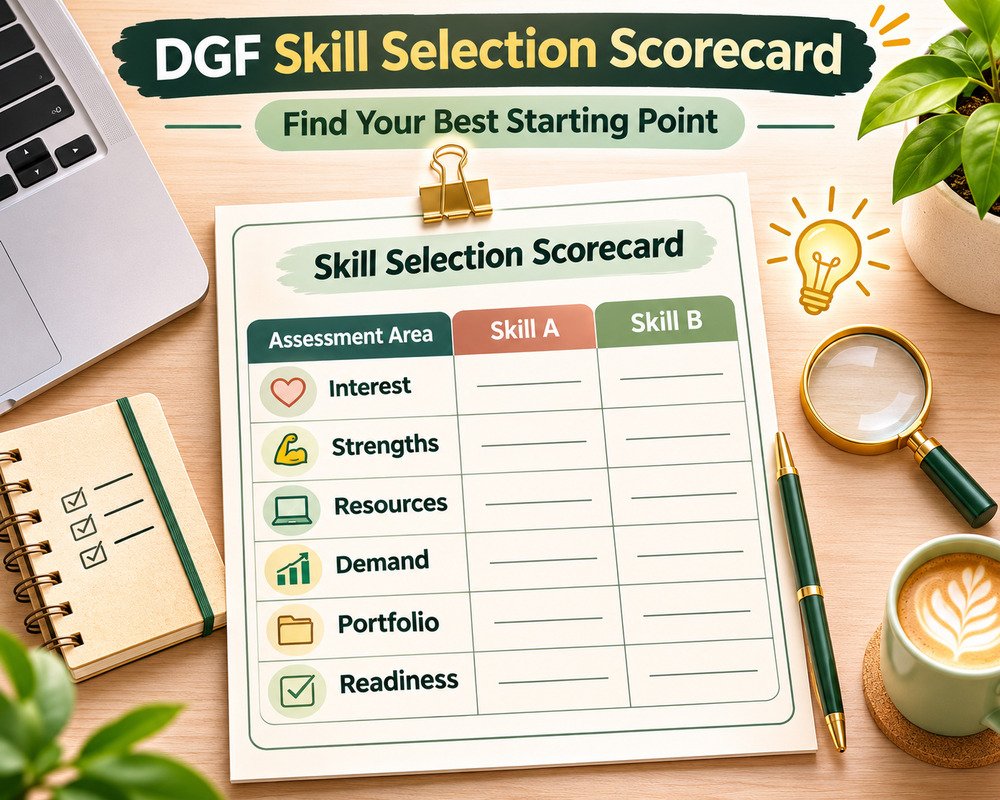
Instead of choosing whatever seems most popular, use the DGF Skill Selection Scorecard to compare two or three skills against your interests, resources, and potential client needs.
Your Freelance Skill Selection Worksheet
Copy this table into a document or spreadsheet. Answer each question with Yes, Partly, or Not Yet, and add a short note explaining your choice.
Decision Question | Skill A | Skill B |
Am I interested in the work? | ||
Does it suit my strengths? | ||
Can I access the required learning resources? | ||
Is there reasonable evidence of client demand? | ||
Can I create a credible portfolio project? | ||
Can I realistically develop professional competence? |
A Completed Example: Content Writing vs. Video Editing
Imagine a beginner who enjoys reading, researching, and explaining ideas but has limited experience with video software.
Here’s how they might complete the worksheet:
Decision Question | Content Writing | Video Editing |
Interest | Yes—enjoys writing. | Partly interested in videos |
Existing strengths | Yes—comfortable researching. | Not yet—little editing experience |
Learning resources | Yes—accessible writing resources | Partly—needs suitable software and practice |
Client demand | Partly—needs to research specific services | Partly—needs to research specific services |
Portfolio potential | Yes — can create a sample article. | Partly—could edit a practice video |
Professional readiness | Not Yet—needs more editing practice | Not Yet — needs technical training |
For this fictional beginner, content writing may be the more practical starting point because it builds on existing strengths. Video editing remains an option worth exploring later.
How to Use Your Results
Look for a skill that combines genuine interest, realistic learning requirements, and evidence of the services clients need.
A not-yet answer isn’t necessarily a reason to reject a skill. It may simply highlight something you need to learn or investigate.
Remember:
This scorecard is an original DGF planning exercise, not a scientifically validated method for predicting freelance earnings or success.
Your next goal is to choose one skill to explore seriously. You can investigate a more specific freelance niche once you’ve developed a clearer understanding of the work.
How to Turn a Freelance Skill Into a Service Clients Understand
Knowing a tool doesn’t automatically tell a potential client what you can deliver. Imagine a tutoring business that needs a website explaining its classes and handling inquiries. “I know WordPress” doesn’t explain whether you can solve that problem.
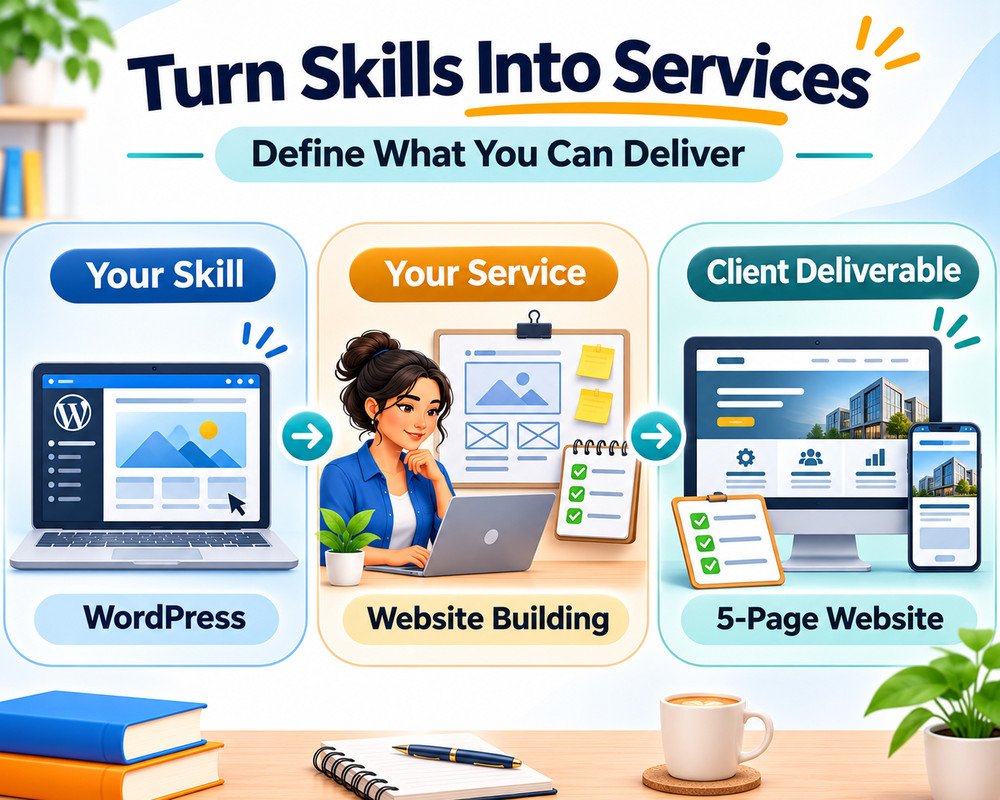
Unclear offer: “I know WordPress.”
Clearer offer: “I can build a responsive five-page informational website for a small business, including agreed page content, a contact form, and a basic handover.”
The second version makes the service easier to understand because it describes the work and its outcome. Before offering something similar, define:
- Client problem: What needs to work better?
- Work involved: What will you actually do?
- Deliverables: Which pages, features, or files will the client receive?
- Scope and limits: What’s excluded, and what requires extra agreement?
- Quality expectations: How will you check mobile layout, forms, and usability?
For that tutoring business, a clear proposal might specify five pages, client-provided class details, mobile testing, and instructions for updating schedules. It should explain whether hosting, maintenance, or later revisions are included.
Only promise what you can deliver competently. A practice site can demonstrate your skills; it doesn’t automatically qualify you to manage every client project. For the broader process of preparing for freelance work, see How to Start Freelancing: A Step-by-Step Guide for Beginners.
A Practical Learning and Portfolio Roadmap
Choosing a skill is a start. The next challenge is turning what you’ve learned into work you can explain, evaluate, and show to a potential client. Rather than collecting courses, follow a manageable process.
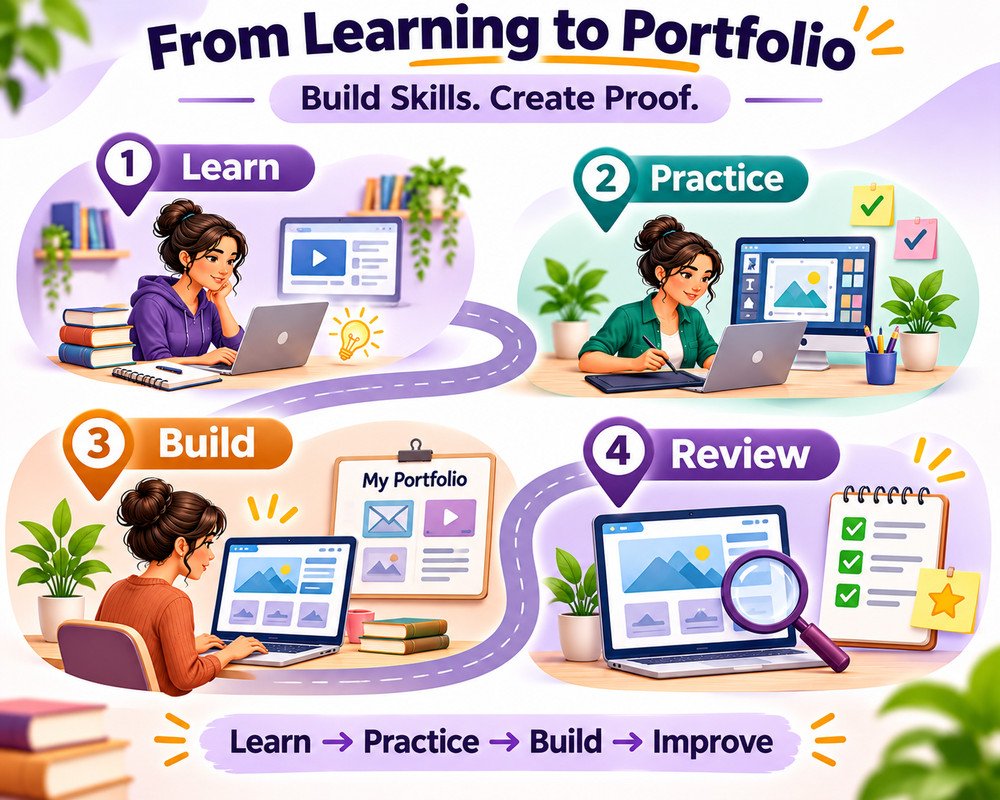
Phase 1—Learn the Fundamentals
Choose a reputable course, official guide, or experienced instructor that covers the basics of your skill. Learn the essential terms and tools before paying for expensive subscriptions. For example, an aspiring WordPress freelancer should understand pages, navigation, responsive layouts, and forms before attempting an entire website.
Phase 2—Practice on Small Tasks
Try short exercises you can finish and check. Build one page, edit one article, or organize one spreadsheet. When something goes wrong, investigate it instead of immediately copying the tutorial again. The goal is to understand your decisions and repeat the task independently.
Phase 3—Complete One Portfolio Project
Choose a realistic assignment resembling a client’s request. A beginner web designer might build a five-page demonstration site for a fictional tutoring business. Clearly label it as a sample; don’t invent client feedback, sales, or performance results. Before sharing it, check that images, text, fonts, and example data are original or properly licensed for use.
Use this DGF First Portfolio Project Brief to explain your work:
Client Problem → Proposed Deliverable → Work Completed → Quality Checks → Lessons Learned
Phase 4—Review Your Work and Improve
Test the result for accuracy, usability, and completeness. Ask a knowledgeable person for feedback if possible, then revise the project and document what changed. Think about whether you could explain requirements and communicate progress to a real client.
Remember:
Learning time varies with the skill, your starting experience, available resources, and the quality expected. A finished practice project is evidence of progress—not automatic proof you’re ready for every paid assignment.
How AI Is Changing Freelance Skills in 2027
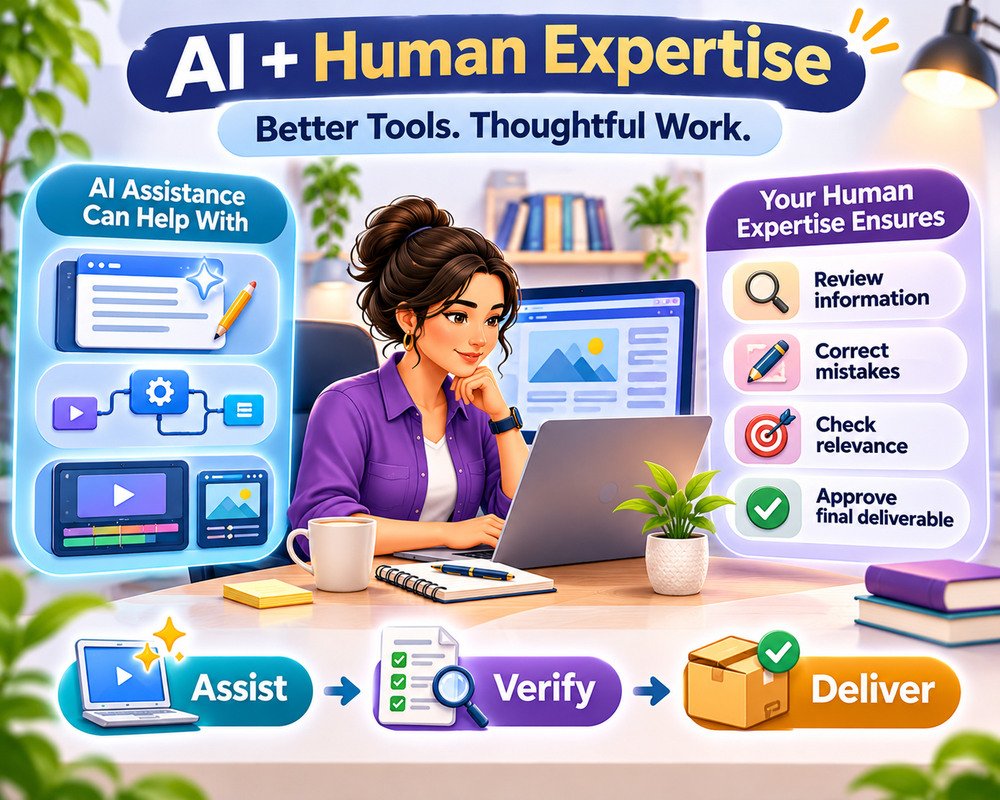
AI is changing how freelancers work, but it hasn’t removed the need for people who understand what clients actually want.
A writer might use AI to brainstorm an outline; a designer to explore concepts; a video editor to prepare captions; or a developer to investigate code. Automation specialists may connect tools to handle repetitive tasks.
In every case, the client still needs a useful, accurate deliverable, not simply access to an AI app.
For example, an AI-assisted content writer must understand the audience, verify factual claims, revise awkward passages, and check that the finished article is original and appropriate.
Freelancers also need to protect confidential client information and respect the rights attached to images, text, and other materials.
Upwork’s 2026 skills research reported growth in AI-related freelance work, while Fiverr’s 2026 Business Trends Index recorded increased searches for AI services. These are 2026 marketplace signals—not guarantees about 2027.
The opportunity is to combine practical expertise, responsible AI use, and human judgment rather than chase every new tool.
Frequently Asked Questions
1. Which Freelance Skill Is Best for Beginners in 2027?
No single freelance skill is best for everyone in 2027. Content writing or virtual assistance may appeal to someone who enjoys communication and organization; web development may suit a person who likes technical problems.
Compare your strengths and learning resources with evidence that clients purchase the service. Then consider whether you can build a credible portfolio sample before offering paid work.
2. Which Freelance Skills Have the Highest Income Potential?
Specialized services that solve difficult or valuable business problems can command higher fees, but no skill guarantees high income.
Earnings depend on experience, demonstrated results, project complexity, client budgets, and how consistently you find suitable work. Don’t confuse advertised hourly rates or employee salaries with what a beginner freelancer takes home after unpaid time, expenses, and taxes.
3. Can I Learn Freelancing Skills Without a Degree?
Yes, many freelance skills can be learned through reputable online resources, practice projects, and feedback without a formal degree. A portfolio showing accurate, usable work can help clients assess your ability.
However, some specialized assignments, regulated activities, or individual clients may require qualifications, certifications, or experience. Check those requirements before describing yourself as ready to provide a service.
4. How Long Does It Take to Learn a Freelance Skill?
There is no reliable timeline that applies to every freelance skill. Learning basic editing commands may take far less preparation than building secure software or managing a client’s advertising budget.
Separate three milestones: understanding the fundamentals, producing a strong independent sample, and delivering consistent client-quality work. Your starting knowledge, practice time, feedback, and the project’s complexity all affect progress.
5. Do I Need Coding Skills to Start Freelancing?
No.
Freelance writing, virtual assistance, graphic design, social media support, and many marketing services can be performed without programming. WordPress and other visual builders also allow some website work without writing code.
However, custom web development and certain complex software integrations typically require coding knowledge. Choose the technical depth that matches the services you want to offer, not a trend.
6. Are AI Skills Better Than Traditional Freelance Skills?
Not necessarily. AI can support drafting, design exploration, data handling, and workflow automation, but knowing a tool is not enough to produce reliable client work. Strong domain knowledge helps you recognize mistakes, protect confidential information, and deliver suitable results. A writer who verifies facts or a developer who tests AI-assisted code may offer more value than someone relying on output alone.
Conclusion: Choose One Skill and Start Building Your Ability
Choosing a freelance skill isn’t about chasing trends or the highest advertised pay. It’s about finding work you can learn and deliver well for clients.
Shortlist two or three skills from this guide. Use the DGF Skill Selection Scorecard to compare your strengths, resources, and evidence of client demand. Choose one realistic direction, then build a portfolio project that shows what you can do.
You don’t need to master everything at once. Focus on consistent practice, feedback, and improving your work.
For the broader journey, read How to Start Freelancing: A Step-by-Step Guide for Beginners.
Remember: A freelance career begins with becoming genuinely useful at something—not endlessly collecting new skills.
