

Want to start freelancing but have no idea what to offer—or how to find someone willing to pay for it?
Maybe you’ve heard about platforms like Upwork and Fiverr, but creating an account feels overwhelming when you don’t have a portfolio, clients, or a clear service to offer.
Here’s something worth understanding from the beginning: Freelancing isn’t simply about joining a platform. It’s about using your skills to solve real problems for clients.
And you don’t need to figure everything out at once.
In this step-by-step guide to starting freelancing, you’ll learn how to choose a service, build a beginner portfolio, set your starting rates, find potential clients, write proposals, and prepare for your first paid project.
You’ll also discover practical planning tools, including a First Freelance Offer Card and a realistic 14-day preparation roadmap to help you turn your interest in freelancing into a clear action plan.
What Do You Need to Start Freelancing?
Starting freelancing doesn’t necessarily require an expensive laptop, a professional degree, or years of work experience. What matters most is having a useful skill and being able to deliver work that meets a client’s expectations.
Before looking for your first freelance project, make sure you have these five essentials:
A marketable skill: Something you can offer to solve a client’s problem, such as writing, graphic design, or video editing.
Practical ability: Enough knowledge and practice to complete your chosen service properly.
Basic tools: Suitable equipment, software, and reliable internet access, depending on the work.
Time and commitment: The ability to communicate with clients, meet deadlines, and complete agreed tasks.
A willingness to improve: Openness to feedback, continued learning, and developing your skills.
Here’s a simple example. Suppose you’re good at writing clear, engaging product descriptions. That could become a freelance service for online stores.
But before approaching clients, you should practice writing descriptions and prepare a few original samples that demonstrate your ability.
You don’t need to be an expert in everything. However, certain regulated professional services may require specific qualifications, certifications, or licenses.
The important difference is this: Being interested in freelancing is a starting point. Being ready to freelance means you can confidently offer and deliver a specific service.
Step 1: Choose One Freelance Service You Can Offer
You might already have a skill that could help you start freelancing. But knowing how to do something and knowing how to offer it as a service are two different things.
Think about it from a client’s perspective. A business owner isn’t simply looking for someone who can write, design, or edit videos. They’re looking for someone who can complete a specific task or solve a particular problem.
That’s why choosing a clear freelance service is an important first step.
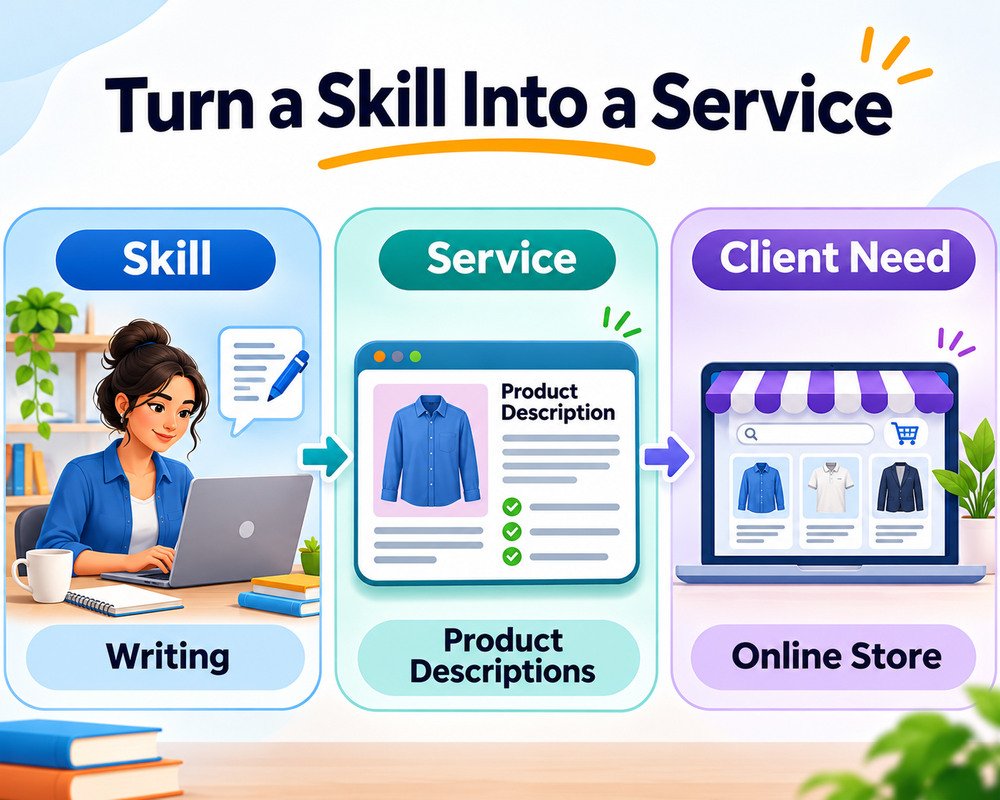
From a Skill to a Service
A skill is something you know how to do. A freelance service is the specific work you offer to clients using that skill.
For example, imagine you’re comfortable writing and want to work with small online businesses.
Here’s how you could turn that ability into a service:
Skill: Writing
Service: Writing product descriptions
Client Need: Helping online retailers explain their products clearly.
The same approach works with other abilities. Graphic design could become creating social media graphics for businesses. Video editing might become producing short promotional videos, while administrative skills could become organizing spreadsheets or managing appointment schedules.
Notice how each example moves from a general ability to a specific service someone might need.
As a beginner, avoid offering too many unrelated services at once. It can make your profile confusing and leave potential clients unsure about what you actually do.
Instead, choose one service you can realistically practice, improve, and deliver well.
Remember:
You don’t need to offer everything. Start with one clear service, build confidence through practice, and expand your offerings as your abilities and experience grow.
Step 2 — Understand Who Might Pay for Your Service
You’ve chosen a freelance service. But here’s an important question: Who actually needs it, and what problem can you help them solve?
Not every client has the same expectations. A small online store, a growing startup, and an established company may have different budgets, project requirements, deadlines, and business goals.
Understanding these differences helps you identify opportunities that match your skills.
Imagine you’re offering product-description writing. A small online clothing store might have listings that mention only prices and sizes, leaving customers with little information about fabric, fit, or product features.
The owner might benefit from clearer descriptions that help shoppers understand what they’re buying.
But how can you discover what potential clients need?
Start by exploring publicly available freelance job postings, business websites, and genuine project requests. Notice which tasks businesses frequently mention, what problems they’re trying to solve, and what results they expect.
As you research, pay attention to:
Client requirements: What specific tasks, skills, or deliverables are they looking for?
Budget and expectations: What level of work, timeline, and budget does the project involve?
Business goals: What problem is the client trying to solve through the project?
Ask yourself:
“Who needs this service, and what specific problem would my work help solve?”
For example, you might initially focus on small online clothing retailers rather than trying to serve every type of business.
Remember, identifying a potential need doesn’t guarantee someone will hire you. It simply helps you approach freelancing with a clearer direction.
The goal is to find clients whose needs match what you can realistically offer.
Step 3—Practice Your Skill and Build a Small Portfolio
How can you convince someone to trust your skills when you haven’t worked with a paying client yet?
That’s where a freelance portfolio comes in. A portfolio is a collection of work samples that helps potential clients understand what you can do and the quality of work they might expect.
The good news? You don’t need previous freelance clients to create one.
What Should a Beginner's Portfolio Include?
Let’s continue with our product-description writing example.
Imagine you’re preparing to offer writing services to small online clothing stores. You could create two original product descriptions and one short category-page description for a fictional store.
For instance, you might write descriptions for a cotton shirt and a casual blazer, followed by introductory copy for a men’s clothing category.
To make each sample meaningful, include:
- The task: What were you trying to create or improve?
- The intended audience: Who would read or benefit from the content?
- The finished work: What exactly did you produce?
You can organize these samples in a Google Doc, a simple PDF, a personal portfolio page, or a portfolio section on a freelancing platform.
According to Upwork’s portfolio guidance, beginners can showcase personal projects and fictional examples, provided they’re clearly identified as practice work rather than paid client assignments.
Always label your practice projects honestly. Never invent client testimonials, professional experience, or impressive sales results to make your portfolio appear more established.
Remember, your first portfolio doesn’t have to be perfect or extensive.
A few relevant, well-prepared samples can demonstrate your abilities more clearly than a long list of skills without supporting work.
Step 4 — Define Your First Freelance Offer and Starting Price
You’ve chosen a service and prepared a few work samples. But what happens when a potential client asks, “What exactly will you do for me, and how much will it cost?”
That’s where a clear freelance service offer becomes important.
Instead of simply saying, “I provide writing services,” imagine telling a client, “I write five original product descriptions for online stores using the product details you provide.”
The second statement is much clearer. It explains what the client can expect and gives you a starting point for discussing the project.
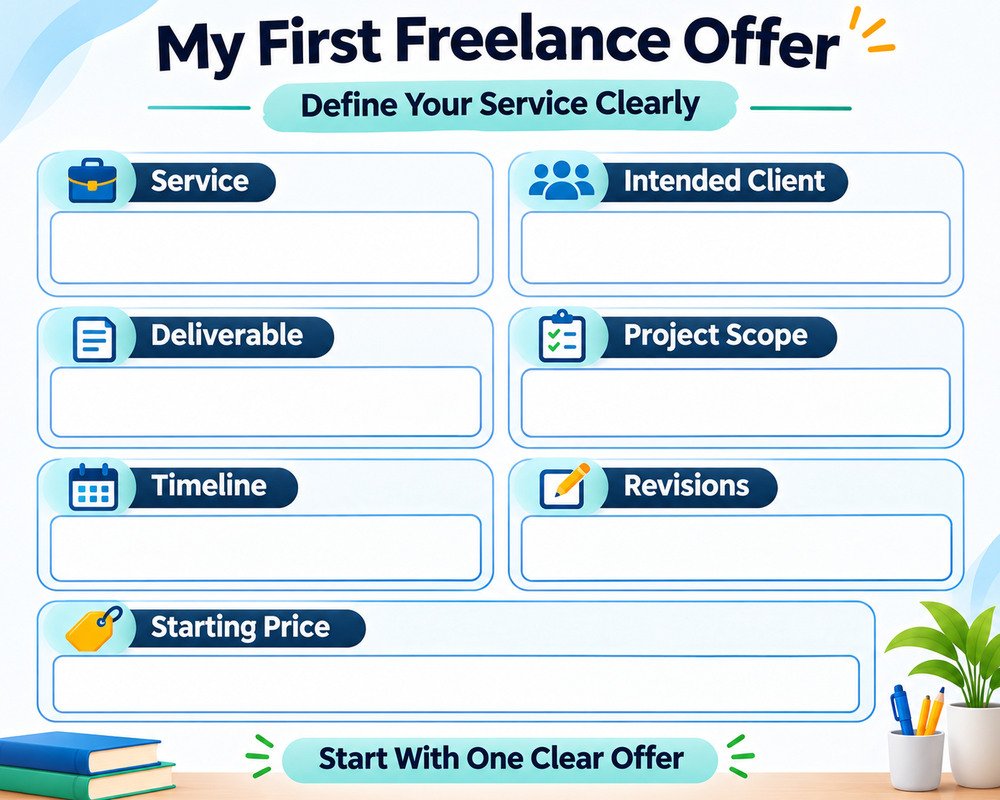
What Should Your First Freelance Offer Include?
Before creating a service listing or sending proposals, take a few minutes to define your offer.
To make this easier, use Digital Growth Flow’s First Freelance Offer Card, a simple planning worksheet designed to help beginners organize their services.
Field | Your Answer |
Service | |
Intended client | |
Deliverable | |
Project scope | |
Delivery timeline | |
Included revisions | |
Starting price |
You don’t need to finalize every detail immediately. Some information, such as deadlines and pricing, may depend on the client’s specific requirements.
The purpose is to understand what you’re offering before agreeing to deliver it.
A Completed Freelance Offer Example
Let’s continue with our beginner content writer who wants to work with small online clothing stores.
Here’s what a completed offer might look like:
Service: Product description writing
Intended Client: Small online clothing stores
Deliverable: Five original product descriptions
Project Scope: Writing based on five product briefs provided by the client
Delivery Timeline: Agreed before starting the project
Included Revisions: One agreed revision round
Starting Price: Quoted after estimating the work involved
This is an illustrative example, not an actual client project or a verified market-rate quotation.
Now comes another important question: How should you decide what to charge?
You can set an hourly rate or agree on a fixed price for a clearly defined project. According to Upwork’s guide to setting freelance rates, pricing depends on factors such as experience, project complexity, and the type of work involved.
Before quoting a price, consider:
Time and effort: Estimate how long research, writing, editing, and communication might take.
Project requirements: Consider the deadline, complexity, and number of revisions.
Expenses and fees: Account for software costs, applicable platform fees, and unpaid administrative work.
There’s no universal starting rate that suits every freelancer. Your price should reflect the work involved, your current abilities, and the expectations you’ve agreed on with the client.
Key Takeaway:
Start with one well-defined service and a realistic pricing approach. A clear freelance offer helps clients understand what they’ll receive while helping you manage your commitments professionally.
Step 5—Create a Professional Freelance Presence
You’ve chosen your service, prepared portfolio samples, and defined what you can offer. Now it’s time to present yourself professionally so potential clients can understand what you do.
Think of your freelance profile as your online introduction. It should communicate your abilities clearly and give clients a reason to explore your work.
For example, instead of writing “Freelancer Available for Work,” you could use a more specific title like “Product Description Writer for Online Stores.”
A professional freelance profile should include:
A clear service description: Explain what you offer and which clients you aim to help.
Relevant skills and portfolio samples: Show examples that demonstrate your ability to complete the work.
Professional contact or inquiry options: Make it easy for potential clients to discuss their requirements through appropriate channels.
Keep your introduction honest, concise, and focused on what you can realistically deliver.
Marketplace Profiles vs. Independent Portfolios
There are different ways to build your online freelance presence.
On Upwork, freelancers can create professional profiles, showcase their skills and work samples, and submit proposals for relevant projects.
Meanwhile, Fiverr allows freelancers to create service listings called Gigs, where they describe specific services clients can purchase.
Alternatively, you can build an independent portfolio using a simple website or professional page. This gives you a place to showcase your work and share it with potential clients outside freelance marketplaces.
Before registering anywhere, check the platform’s eligibility requirements, identity-verification process, available features, and service rules, as these can vary.
Remember:
You don’t need to join every freelancing website immediately. Start with a professional presence that suits your service, then expand as you gain experience.
Step 6 — Where to Find Freelance Clients: Platforms, Networks, and Direct Outreach
You’ve developed your skills, prepared portfolio samples, and created a professional freelance profile. Now comes an important question: Where can you find people who might actually need your services?
The good news is that freelance opportunities aren’t limited to one website. You can explore online marketplaces, build professional connections, or approach relevant businesses directly.
The key is to look for clients whose needs match what you can confidently deliver, rather than applying for every available project.
Popular Freelancing Websites for Beginners
Freelancing websites connect independent professionals with businesses and individuals looking for specific services.
However, these platforms work differently. Some allow you to apply for advertised projects, while others let you create service listings that potential clients can discover.
Here are five established platforms worth exploring:
Platform | How It Works | Official Resource |
Upwork | Create a profile, submit proposals, or offer predefined services. | |
Fiverr | Create service listings, called Gigs, that explain what clients can purchase. | |
Freelancer.com | Browse available projects and submit competitive bids. | |
Contra | Showcase your portfolio, build a professional presence, and explore project opportunities. | |
Guru | Search for freelance jobs and send quotations to potential clients. |
You don’t need to register on all five platforms immediately. Instead, explore which ones offer relevant opportunities for your particular service.
Before choosing a platform, consider:
Project relevance: Are clients looking for services you can realistically provide?
Fees and requirements: What are the platform’s charges, eligibility rules, and account requirements?
Payment options: Are suitable withdrawal methods available in your country?
Remember, no freelancing website can guarantee that you’ll find clients or secure paid projects. Your skills, portfolio, communication, and suitability for each opportunity still matter.
Finding Clients Beyond Freelancing Websites
What if you don’t want to depend entirely on freelance marketplaces?
You can also explore professional networking, referrals, and thoughtful direct outreach.
For example, imagine you’re offering product-description writing to small online clothing retailers.
You might discover a store with incomplete product descriptions while browsing its public website. After understanding its products and audience, you could introduce your service through an appropriate business contact channel and share a relevant portfolio sample.
The goal isn’t to send identical promotional messages to hundreds of businesses. It’s to approach suitable potential clients respectfully, with a clear understanding of how you might help.
Professional contacts and genuine referrals may also introduce opportunities as you build relationships.
Key Takeaway:
Finding freelance clients isn’t about being everywhere. Start with a few relevant channels, understand what potential clients need, and focus on opportunities that genuinely match your abilities.
Step 7 — Write a Clear and Personalized Freelance Proposal
You’ve found a freelance project that matches your skills. Now, how do you convince the client that you’re the right person to consider?
That’s where a freelance proposal comes in. It’s your opportunity to introduce your service, demonstrate that you understand the client’s needs, and explain how you could help.
But here’s something important: A good proposal focuses on the client’s problem, not just the freelancer’s qualifications.
What Makes a Good First Proposal?
Instead of sending the same generic message to every client, take a few minutes to understand what each project requires.
According to Upwork’s proposal-writing guide, effective proposals address the client’s specific needs, highlight relevant abilities, and include suitable work samples.
Your first freelance proposal should communicate four things:
The client’s needs: Show that you’ve understood the project and its requirements.
Your proposed service: Explain what you can do and how you’ll approach the work.
Relevant evidence: Share an original portfolio sample that demonstrates your abilities.
A clear next step: Invite the client to discuss project details before proceeding.
Here’s a simple example.
Imagine a small online clothing retailer looking for someone to write product descriptions.
You could send a proposal like this:
Hello,
I noticed you’re looking for someone to write clear, engaging product descriptions for your clothing store.
I can help create descriptions that highlight important details such as fabric, fit, and product features using the information you provide.
I’ve prepared a few original practice samples that I’d be happy to share so you can review my writing style.
If you’re interested, we can discuss the products, preferred tone, and deadline before agreeing on the project.
Thank you for considering my proposal.
Notice that this message is specific, professional, and focused on the client’s requirements. It doesn’t make exaggerated promises or pretend the freelancer has completed paid projects.
Remember, different freelancing platforms have different proposal formats and communication policies. For example, Upwork’s communication guidelines generally require freelancers to keep pre-contract conversations on the platform.
Key Takeaway:
A strong freelance proposal isn’t about using impressive words or promising extraordinary results. It’s about showing that you understand the client’s needs and can offer a relevant, realistic solution.
Step 8 — Agree on Scope, Payment, and Project Boundaries
Getting your first freelance project offer can feel exciting. But before saying yes, there’s something equally important to consider: Do you and your client clearly understand what you’re agreeing to?
Even a small project can lead to misunderstandings when expectations, deadlines, or payment arrangements aren’t discussed beforehand.
That’s why establishing clear project terms is an essential part of freelancing professionally.
What Should You Confirm Before Starting?
Imagine a clothing retailer agrees to hire you to write five product descriptions. You discuss the price, but what happens if the client later requests ten descriptions instead?
Without a clearly defined agreement, you could end up doing additional work that wasn’t included in your original offer.
Before accepting a freelance project, use this simple checklist:
Before You Accept the Project
Scope and deliverables: Confirm exactly what you’ll create and what information the client will provide.
Deadlines and revisions: Agree on the delivery date, included revisions, and how additional requests will be handled.
Payment arrangements: Clarify the total price, payment schedule, and agreed payment method.
Ownership and confidentiality: Discuss who can use the finished work and whether any information must remain private.
These details don’t necessarily require a complicated document. However, keeping the agreed terms in writing helps both parties understand their responsibilities.
For additional guidance, Freelancers Union’s Contract Creator provides a useful resource for understanding common freelance agreement terms.
Protect Yourself From Common Freelance Scams
Unfortunately, not every freelance opportunity is genuine.
You might encounter someone pretending to represent a company, offering unusually attractive work, or requesting money before providing a project.
For example, a supposed recruiter might claim that you must pay a registration or training fee before receiving a job. Others may request sensitive personal or financial details before you’ve verified who they are.
The Federal Trade Commission (FTC) warns job seekers about fraudulent opportunities involving upfront payments and misleading offers.
Before sharing sensitive information or accepting a project, verify the client’s identity where possible, review the platform’s rules, and use appropriate payment safeguards.
If you’re working through a freelance marketplace, understand how its payment protection works and what conditions apply.
Key Takeaway:
A promising freelance opportunity is only a good starting point. Clear agreements, sensible payment arrangements, and basic safety checks help you approach your first project with greater confidence.
Step 9 — Deliver Your First Freelance Project Professionally
Getting your first freelance project is exciting. But securing the work is only the beginning. How you communicate, complete, and deliver a project helps shape the client’s experience.
Let’s return to our beginner writer, who has agreed to create five product descriptions for a small online clothing store.
Before writing, the freelancer should confirm the product details, intended audience, writing style, deadline, and revision terms. If anything is unclear, asking questions early is better than making assumptions.
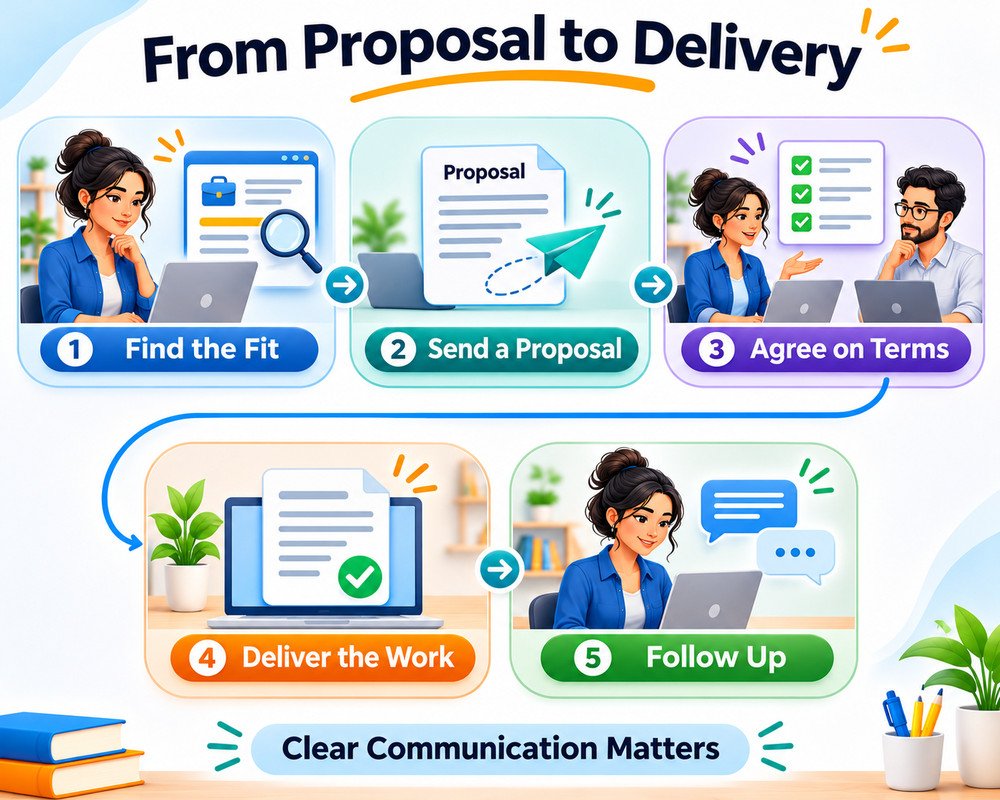
A Simple First-Project Handoff
Once the requirements are clear, follow a manageable process:
Complete the work: Write the five descriptions using the agreed information and keep project files organized.
Check quality: Review accuracy, spelling, consistency, and whether each description meets the client’s instructions.
Submit and follow up: Deliver the files through the agreed method, explain what’s included, and handle revisions within the agreed scope.
Communication matters throughout the project. Set realistic deadlines, provide important progress updates, and inform the client promptly if something might delay delivery.
Upwork’s beginner guide also emphasizes clear communication, realistic expectations, and professional project delivery.
If you’re working through a marketplace, follow its official submission requirements. For example, Upwork explains that fixed-price milestone work must be formally submitted through the relevant contract process.
After completing a project, keep accurate records of the deliverables, agreed revisions, and feedback. Clients may leave reviews, but positive feedback is never guaranteed.
Before adding completed client work to your portfolio, check your agreement and obtain permission where required, particularly when confidential information is involved.
Key Takeaway:
Professional freelance delivery isn’t just about finishing the work. It’s about meeting expectations, communicating clearly, and completing every project responsibly.
Common Freelancing Mistakes Beginners Should Avoid
Starting a freelance career involves learning new skills, understanding clients, and managing your own work. It’s natural to make mistakes along the way.
However, some common freelancing mistakes can lead to unnecessary stress, missed opportunities, or payment problems. Recognizing them early can help you make better decisions.
Here are five mistakes worth avoiding.
Mistake 1 — Offering Services Before You're Ready
Being interested in a skill doesn’t automatically mean you’re ready to provide it professionally.
How to avoid it: Practice your chosen service, prepare relevant work samples, and accept projects you can realistically complete.
Mistake 2 — Sending Generic Proposals to Every Project
Applying to unrelated jobs with identical messages can make it difficult to demonstrate why you’re suitable.
How to avoid it: Focus on relevant opportunities and personalize each proposal around the client’s requirements. Upwork’s beginner guidance also emphasizes understanding your market and communicating effectively.
Mistake 3 — Accepting Projects Without Clear Agreements
Unclear deadlines, deliverables, or payment arrangements can create misunderstandings after work begins.
How to avoid it: Confirm the project scope, price, timeline, and revision terms in writing before starting.
Mistake 4 — Promising More Than You Can Deliver
Accepting unrealistic deadlines or claiming skills you haven’t developed may damage client trust.
How to avoid it: Be transparent about your abilities, estimate the work carefully, and agree only to commitments you can reasonably meet.
Mistake 5 — Ignoring Suspicious Freelance Opportunities
Fake recruiters, unusual payment requests, and promises of easy earnings can put beginners at risk.
How to avoid it: Verify potential clients, protect sensitive information, and never pay someone to obtain a promised job. The Federal Trade Commission (FTC) provides guidance on recognizing fraudulent work opportunities.
Key Takeaway:
You don’t have to get everything right immediately. Start with realistic commitments, communicate clearly, and learn from each experience as you develop your freelance career.
Your First 14 Days: A Freelancing Preparation Roadmap
You’ve learned how to choose a service, build a portfolio, find potential clients, and prepare for your first project. But putting everything into practice can still feel overwhelming.
So, where should you begin?
Instead of trying to accomplish everything at once, break your freelancing preparation into smaller, manageable steps.
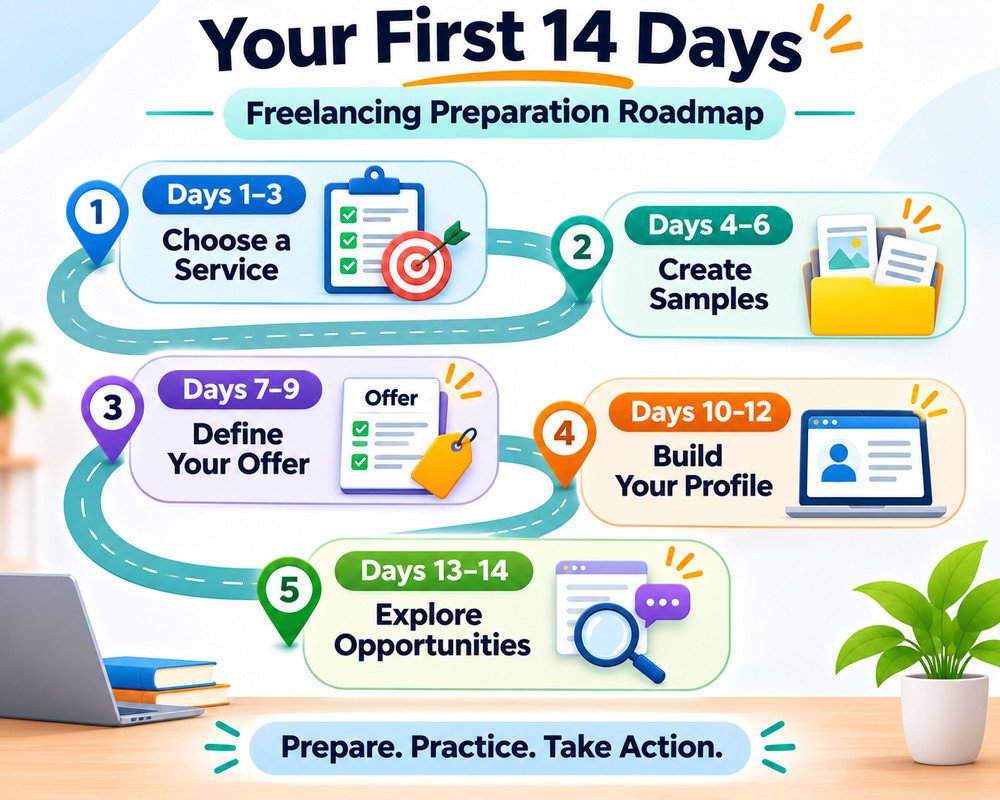
This simple 14-day freelancing roadmap for beginners can help you organize your learning, develop practical materials, and take your first steps toward finding suitable opportunities.
Period | Main Focus | Suggested Action |
Days 1–3 | Choose a service | Identify one suitable skill and a specific client need. |
Days 4–6 | Practice and create samples | Prepare original, clearly labeled practice work. |
Days 7–9 | Define an offer | Complete your First Freelance Offer Card. |
Days 10–12 | Prepare your presence | Organize your portfolio and create a suitable professional profile. |
Days 13–14 | Research opportunities | Review relevant client requests and prepare thoughtful outreach. |
How to Make This Roadmap Work for You
Let’s return to our beginner content writer.
During the first few days, they might decide to offer product-description writing for small clothing stores. Next, they could prepare original writing samples, define a simple service package, and organize their portfolio.
By the end of the roadmap, they might be ready to explore relevant freelance opportunities and prepare their first personalized proposal.
But remember, everyone starts with different skills, experience, and available time. You may need several weeks or longer to become confident in your chosen service, and that’s perfectly reasonable.
This roadmap is a preparation exercise, not a guarantee that you’ll become fully qualified, secure a client, or earn money within 14 days.
Key Takeaway:
Starting freelancing becomes more manageable when you focus on one achievable task at a time. Measure your progress by what you’ve learned and prepared—not how quickly you start earning.
Frequently Asked Questions
1. Can I Start Freelancing Without Experience?
Yes, you can start preparing for freelancing without previous professional experience, provided you develop the skills needed to deliver your chosen service.
Begin by identifying transferable skills, practicing regularly, and creating original portfolio samples that demonstrate your abilities. As Upwork’s portfolio guide explains, relevant work samples can help beginners showcase their skills.
Be honest about your experience rather than inventing previous clients or results. For more detailed strategies, explore our upcoming guide on starting freelancing with no experience.
2. Do I Need a Degree to Become a Freelancer?
Not necessarily. Many freelance services, including content writing, graphic design, and video editing, don’t automatically require a university degree.
What matters is whether you have the knowledge, practical skills, and ability to complete the client’s work.
However, certain professional services may require licenses, certifications, or specific qualifications. Individual clients and freelance platforms may also have additional requirements.
Always check the expectations and applicable regulations for your chosen service before offering it professionally.
3. How Much Does It Cost to Start Freelancing?
The cost of starting freelancing depends on the service you choose and the resources you already have.
You may need a computer, reliable internet, suitable software, or other equipment. Some tools offer free features, while others require subscriptions.
Freelancing platforms may also charge service fees or offer optional paid features.
Remember to consider the time spent learning, preparing samples, communicating, and finding clients. Even when your initial financial expenses are low, freelancing still requires effort and commitment.
4. Do I Need Upwork or Fiverr to Find Clients?
No.
Platforms such as Upwork and Fiverr are useful options, but they aren’t the only ways to find freelance clients.
You can also explore professional networks, referrals, relevant business communities, and thoughtful direct outreach.
For example, a product-description writer might approach online retailers whose needs match their service.
Choose client-discovery methods that suit your skills and circumstances, rather than assuming every freelancer must use a particular marketplace.
5. How Long Does It Take to Get My First Freelance Client?
There’s no fixed timeline for finding your first freelance client. Some beginners may receive opportunities relatively quickly, while others may spend considerably longer preparing and searching.
Your progress depends on factors such as skill readiness, service positioning, competition, client demand, and the quality of your proposals.
Instead of expecting immediate results, focus on improving your portfolio, exploring suitable opportunities, and communicating professionally.
Getting your first client is a milestone, not a race.
Start With One Service and One Realistic Goal
Starting freelancing doesn’t mean you need to join every platform, master dozens of skills, or offer every service imaginable.
Your freelance journey can begin with one useful skill, one clear service, and a realistic plan.
So, what’s your next move?
Choose one service you can confidently develop and complete your First Freelance Offer Card. Then create a relevant portfolio sample to demonstrate your abilities before approaching potential clients.
Remember, building a freelance career takes preparation, consistency, clear communication, and continuous learning. Progress may be gradual, but every practical step helps you become better prepared.
For more guidance, explore Digital Growth Flow’s upcoming articles on freelance skills, beginner-friendly jobs, and choosing a profitable niche.
Our planned Start Freelancing eBook may also offer expanded worksheets and practical exercises to support your learning.
