
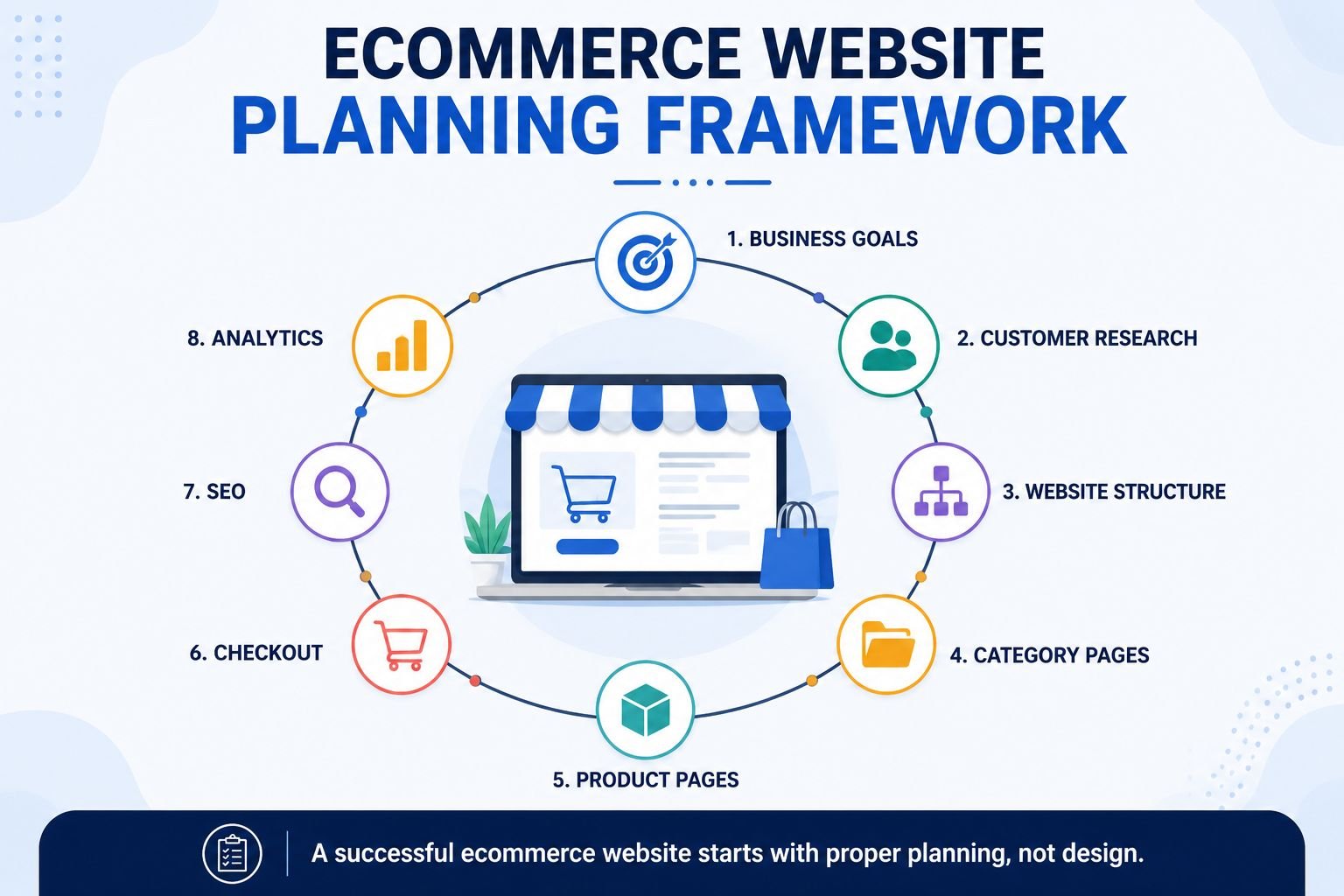
What if your ecommerce website looks great but still gets little traffic and even fewer sales?
For many online stores, the problem starts before the website is even built.
Beginners often focus first on themes, colors, logos, and banners. But they may overlook the things that matter most: customer research, website structure, content planning, SEO, and the buying journey.
That is why learning how to plan an ecommerce website is so important.
A strong ecommerce website plan helps you organize your products, create clear navigation, improve search engine visibility, and make it easier for visitors to buy.
It also gives you a better foundation for long-term growth.
Successful ecommerce stores do not start with design alone.
They start with strategy.
In this guide, you will learn how to plan an ecommerce website from the ground up, including business goals, target audience research, site structure, content, SEO, mobile optimization, essential features, and launch preparation.
The goal is simple: build a store that does more than look professional.
Build one that attracts, converts, and grows.
Section 1: Why E-commerce Website Planning Matters
Imagine two business owners launching an ecommerce website.
The first one spends weeks researching customers, organizing product categories, planning website pages, and creating a clear SEO strategy before development begins.
The second one chooses a theme, uploads products, and starts designing immediately.
Six months later, which website do you think is more likely to attract traffic, generate sales, and support long-term growth?
In most cases, the answer is obvious.
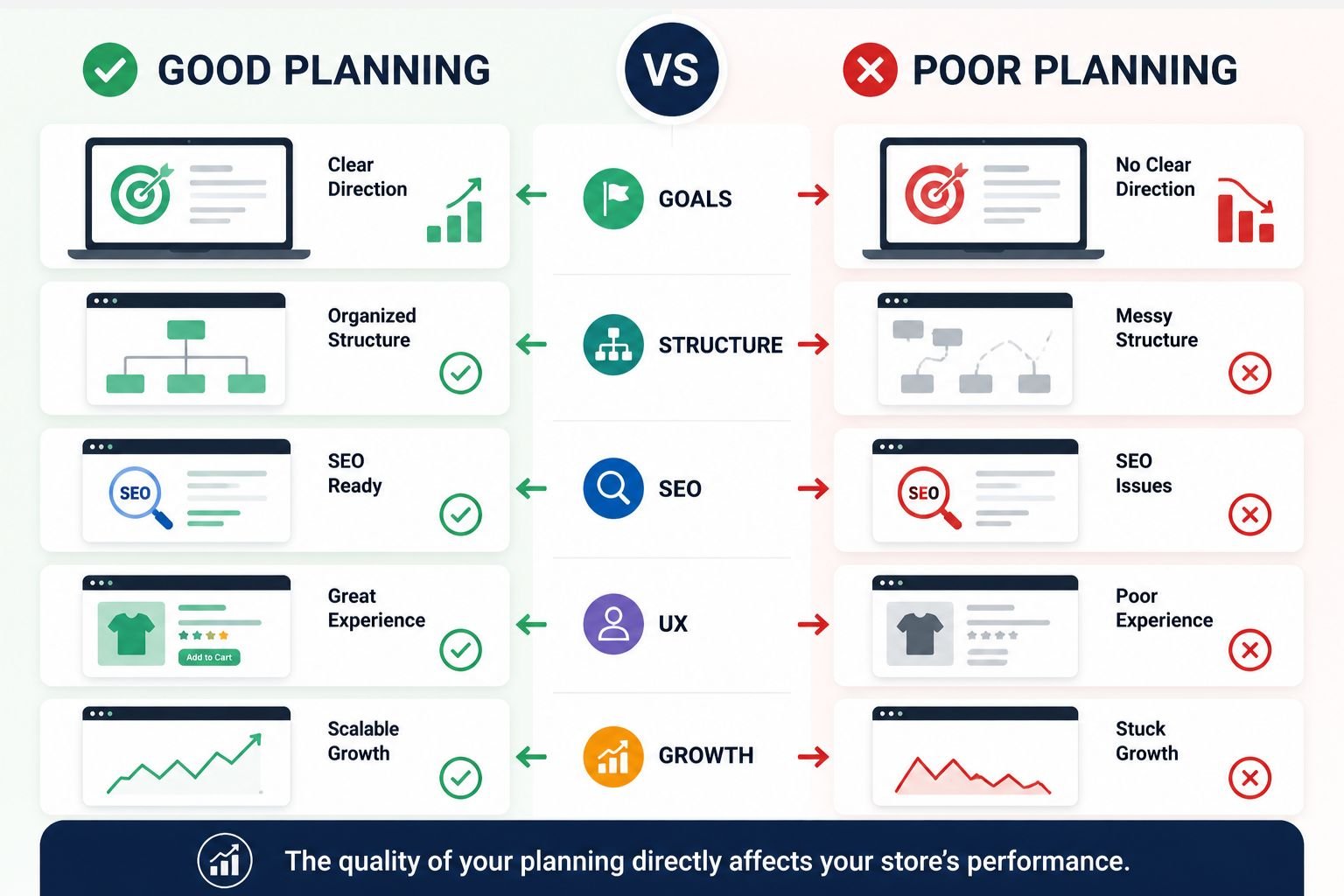
The difference isn’t design.
It’s planning.
A successful ecommerce website isn’t built by accident. Behind every high-performing online store is a strategic plan that guides every decision, from navigation and content to SEO and user experience.
Let’s look at why ecommerce website planning matters so much.
1.1 Planning vs Building
Many beginners treat planning and building as the same thing.
They’re not.
Planning happens before development begins. It’s the process of deciding what your website needs, who it’s for, how it will be structured, and what goals it should achieve.
Building is simply the execution phase.
Think of planning as creating a roadmap before starting a journey.
Without a roadmap, you may still reach your destination, but you’ll likely take unnecessary detours, waste time, and make costly mistakes along the way.
The same applies to ecommerce websites.
When you plan first, every design choice, content decision, and feature serves a clear purpose.
1.2 The Cost of Poor Planning
Poor planning often creates problems that are difficult and expensive to fix later.
For example, imagine launching an online clothing store with hundreds of products but no clear category structure.
At first, it may seem manageable.
However, as new products are added, navigation becomes confusing. Customers struggle to find items, search engines have trouble understanding your website structure, and managing inventory becomes increasingly difficult.
What could have been solved during the planning stage now requires redesigning pages, restructuring categories, and updating internal links.
That’s why planning is always cheaper than fixing mistakes after launch.
1.3 Impact on User Experience
Your website exists for one reason: to help customers find and purchase products.
If visitors feel confused, frustrated, or overwhelmed, they won’t stay for long.
A well-planned ecommerce website creates a smooth user experience from the moment someone lands on your store.
Visitors can easily navigate categories, discover relevant products, compare options, and complete purchases without unnecessary obstacles.
Every page feels connected.
Every click makes sense.
And every step moves customers closer to a purchase.
Good user experience starts long before design. It starts during the planning process.
1.4 Impact on SEO
Many store owners think SEO begins after a website is built.
In reality, some of the most important ecommerce SEO decisions happen during planning.
Your category structure, URL format, internal linking strategy, product organization, and content plan all influence how search engines understand your website.
For example, a well-organized store helps Google crawl pages more efficiently and understand the relationship between categories and products.
This can improve visibility in search results and increase organic traffic over time.
Planning for SEO from the beginning is much easier than trying to fix SEO problems after launch.
1.5 Impact on Conversion Rates
Traffic alone doesn’t grow a business.
Conversions do.
You can attract thousands of visitors every month, but if your website isn’t designed around customer needs, those visitors may never become customers.
Strategic planning helps create a smoother buying journey.
Visitors can quickly find what they’re looking for, access important information, build trust in your brand, and complete purchases with confidence.
The easier it is for customers to buy, the higher your conversion rates are likely to be.
1.6 Long-Term Scalability
Many ecommerce websites are built for today’s needs but not tomorrow’s growth.
That’s a mistake.
A store with 20 products today may have 200 products next year.
New categories may be added. New markets may be targeted. New content may be published.
Without a scalable website structure, growth often creates chaos.
Proper ecommerce website planning ensures your store can expand without requiring a complete rebuild every time your business grows.
Instead of constantly fixing problems, you can focus on attracting customers, increasing sales, and scaling your ecommerce business with confidence.
In short, planning isn’t an extra step in the ecommerce website development process.
It’s the foundation that supports everything else.
Section 2: Define Your Ecommerce Business Goals First
Imagine you’re about to build a new ecommerce website.
Before choosing a theme, designing pages, or uploading products, there’s one important question you need to answer:
What do you want your website to achieve?
It sounds simple, but many business owners skip this step.
They focus on how their website looks without defining what success actually means. As a result, they end up making decisions based on opinions rather than business objectives.
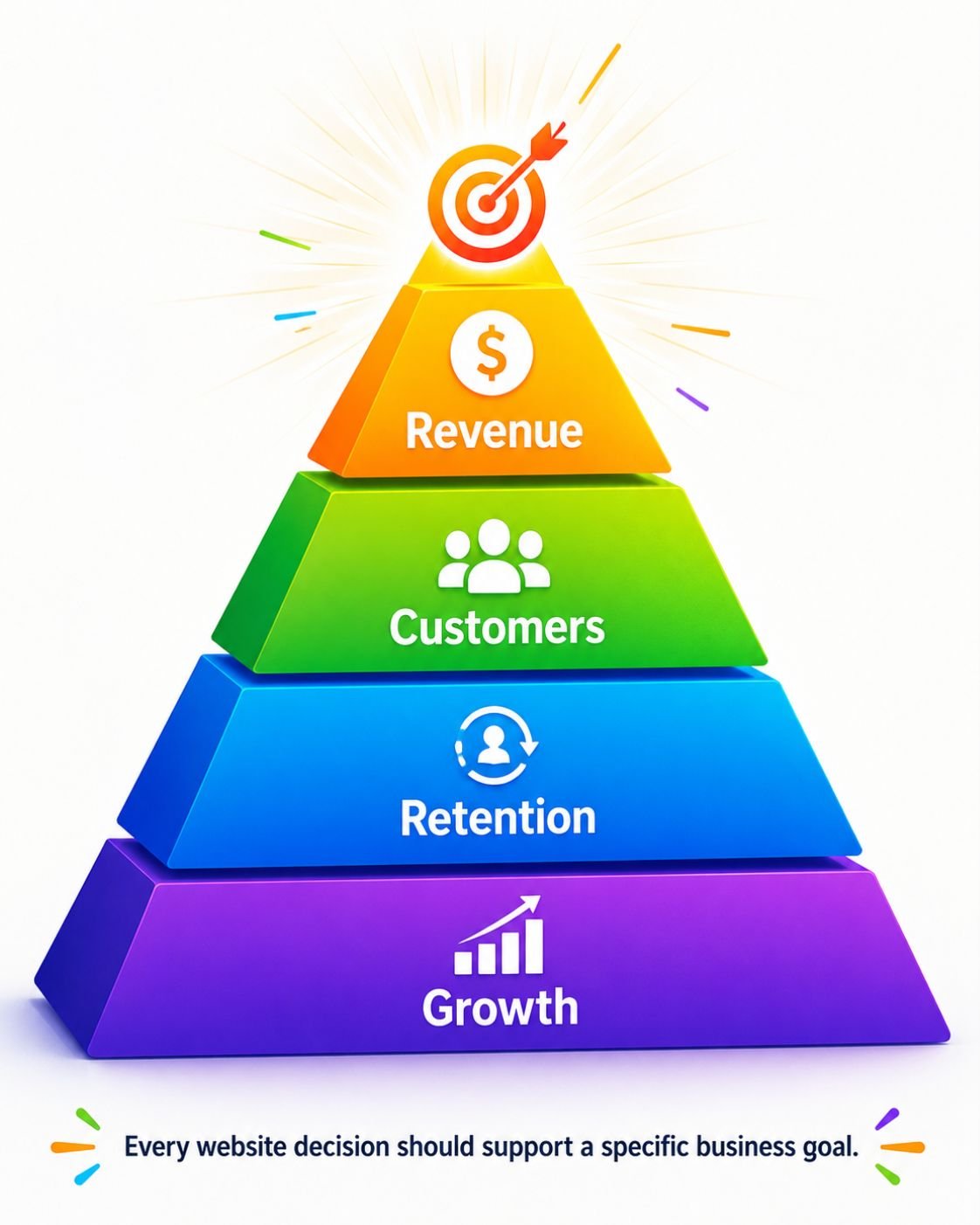
A successful ecommerce website starts with clear goals.
Your goals act as a roadmap, helping you prioritize features, content, marketing efforts, and website improvements that support your business growth.
Let’s look at the most important ecommerce business goals you should define before building your store.
2.1 Revenue Goals
For most ecommerce businesses, increasing revenue is the primary objective.
After all, your website should help generate sales and support business growth.
For example, your goal might be to generate $5,000 per month in online sales within the first six months of launching your store.
Having a specific revenue target makes it easier to create strategies around pricing, product selection, marketing campaigns, and conversion optimization.
Instead of simply hoping for more sales, you’re working toward a measurable outcome.
2.2 Lead Generation Goals
Not every ecommerce website is designed to generate immediate sales.
Some businesses sell high-ticket products, custom services, or products that require consultation before purchase.
In these cases, lead generation becomes a key objective.
For example, you may want visitors to request a quote, schedule a consultation, join a waiting list, or subscribe to your email newsletter.
A website built for lead generation focuses on capturing customer information and nurturing prospects until they’re ready to buy.
2.3 Brand Awareness Goals
Many new ecommerce brands struggle because nobody knows they exist.
That’s why brand awareness can be an important goal, especially during the early stages of business growth.
Your ecommerce website should help introduce your brand, communicate your unique value proposition, and build trust with potential customers.
The more familiar people become with your brand, the more likely they are to return and make a purchase in the future.
2.4 Customer Retention Goals
Acquiring a new customer is often more expensive than retaining an existing one.
That’s why successful ecommerce businesses focus not only on attracting new buyers but also on encouraging repeat purchases.
Your website can support customer retention through loyalty programs, personalized recommendations, email marketing, wishlists, and excellent customer experiences.
A customer who purchases multiple times is usually far more valuable than a one-time buyer.
2.5 Growth Goals
Think beyond today’s needs.
Where do you want your ecommerce business to be one year from now? Three years from now?
Growth goals help you plan for expansion.
This may include launching new product categories, entering new markets, increasing website traffic, or scaling your operations.
When growth is part of your strategy from the beginning, your website can be built to support future opportunities rather than limiting them.
2.6 Use SMART Goals and KPIs to Measure Success
A goal without measurement is simply a wish.
That’s why ecommerce businesses should use SMART goals.
A SMART goal is
- Specific
- Measurable
- Achievable
- Relevant
- Time-bound
For example, “Increase monthly online sales by 25% within the next six months” is much more useful than “Get more sales.”
You should also identify key performance indicators (KPIs) that help measure progress.
Common ecommerce KPIs include:
- Revenue
- Conversion Rate
- Average Order Value (AOV)
- Customer Acquisition Cost (CAC)
- Email Subscribers
- Repeat Purchase Rate
- Organic Traffic
Tracking these metrics allows you to see what’s working, identify opportunities for improvement, and make smarter business decisions.
Before you plan your website structure, content, or features, take time to define your ecommerce business goals.
The clearer your goals are, the easier it becomes to build a website that supports them.
Section 3 — Understand Your Target Audience
Imagine walking into a store where every product feels irrelevant to you.
The prices don’t match your budget. The design doesn’t appeal to you. The products don’t solve any of your problems.
Would you stay and shop?
Probably not.
The same thing happens online every day.
Many ecommerce websites fail because they’re built around what the business wants instead of what customers need. That’s why understanding your target audience is one of the most important steps in ecommerce website planning.
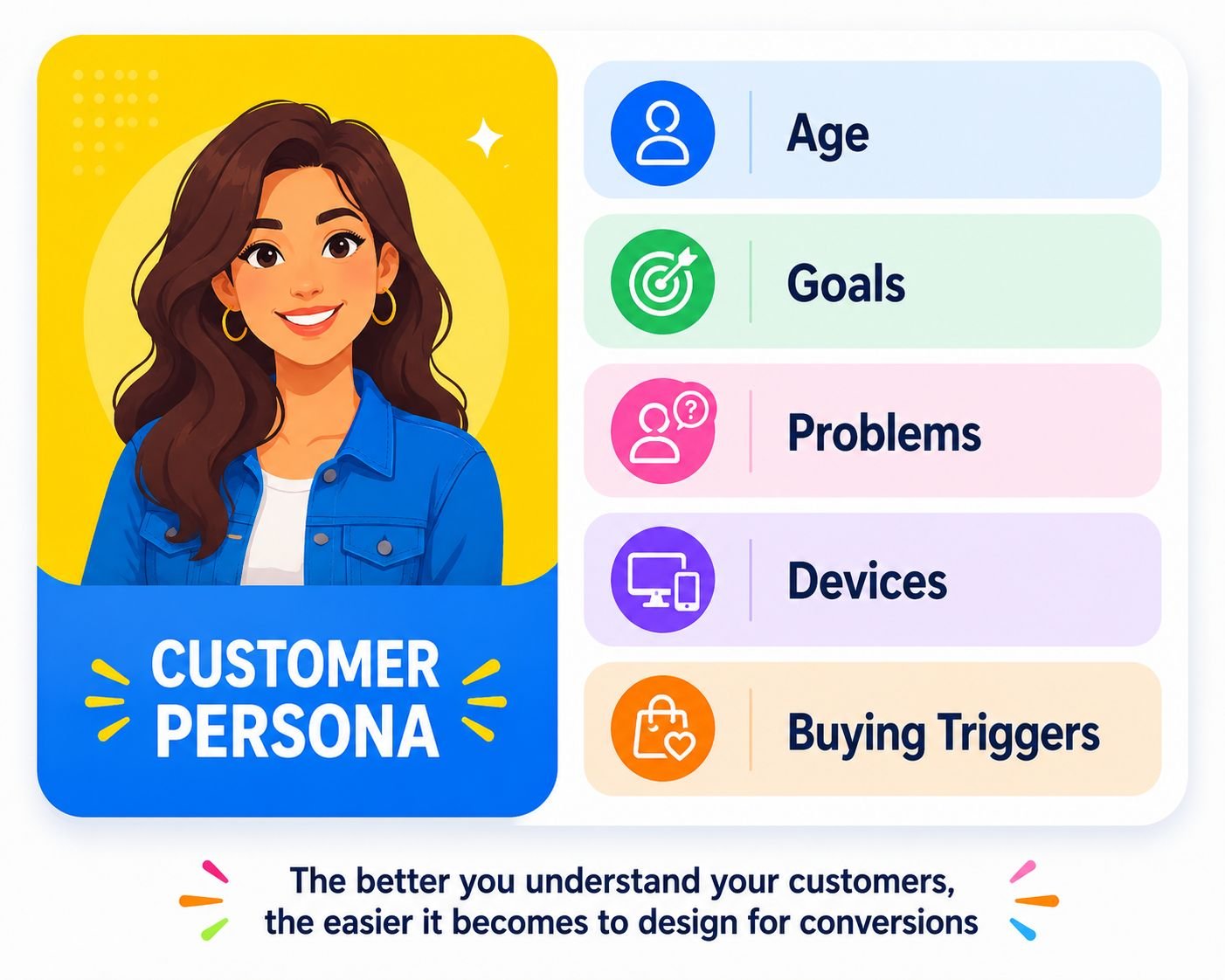
When you know who your customers are, what they care about, and how they shop, you can create a website experience that feels relevant, helpful, and trustworthy.
3.1 Customer Demographics
The first step is understanding the basic characteristics of your audience.
This includes factors such as age, gender, location, income level, occupation, education, and lifestyle.
For example, a luxury watch brand targeting high-income professionals will likely require a different website experience than a budget-friendly fashion store targeting university students.
Customer demographics influence everything from website design and product pricing to content strategy and marketing campaigns.
The better you understand who your customers are, the easier it becomes to create a website that speaks their language.
3.2 Customer Pain Points
Customers don’t buy products.
They buy solutions.
Every purchase is usually driven by a problem, challenge, or desire.
Someone purchasing a standing desk may be trying to reduce back pain. A customer buying skincare products may be looking for a solution to acne. Someone shopping for storage containers may want to organize their home more efficiently.
Understanding customer pain points helps you position your products more effectively.
Instead of focusing only on product features, you can show customers how your products improve their lives.
3.3 Shopping Behavior
Not all customers shop the same way.
Some people spend hours comparing products before making a decision. Others make purchases within minutes.
Some shoppers rely heavily on reviews and ratings. Others focus on price, product specifications, delivery options, or brand reputation.
Understanding shopping behavior helps you create a smoother customer experience.
For example, if your audience likes comparing products, detailed descriptions, product comparisons, FAQs, and customer reviews become extremely important.
The goal is to make the buying process as easy and comfortable as possible.
3.4 Device Preferences
How do your customers access your website?
This question is more important than many business owners realize.
Today, a significant portion of ecommerce traffic comes from mobile devices. Customers often discover products, browse categories, and even complete purchases directly from their smartphones.
If your audience primarily shops on mobile, your website should prioritize responsive design, fast loading speeds, easy navigation, and mobile-friendly checkout processes.
A website that performs well across all devices creates a better user experience and reduces the chances of losing potential customers.
3.5 Purchase Motivations and Purchase Intent
Customers may choose the same type of product for very different reasons. Some care about price, while others value quality, convenience, sustainability, customer service, or brand reputation.
Understanding these priorities helps you highlight the benefits that matter most to your audience and create a website that feels more relevant to them.
Creating customer personas can make this easier. A customer persona is a simple profile of your ideal buyer based on research and real customer behavior. For example, instead of targeting everyone interested in fitness, you might focus on a busy professional looking for convenient home workout equipment.
You should also understand the buyer journey:
- Awareness: The customer realizes they have a need.
- Consideration: They compare possible solutions.
- Decision: They choose a product or brand.
Visitors can also have different levels of purchase intent. Someone searching for “best gaming laptops for students” may still be researching, while “buy ASUS gaming laptop online” shows much stronger purchase intent.
When you understand your customers, their journey, and their intent, you can create an ecommerce website that attracts the right visitors, builds trust, and encourages more sales.
Section 4 — Choose the Right Ecommerce Business Model
Imagine building an ecommerce website without knowing how your business will actually operate.
You might create pages, add products, and invest in marketing, only to realize later that your website doesn’t support your business goals.
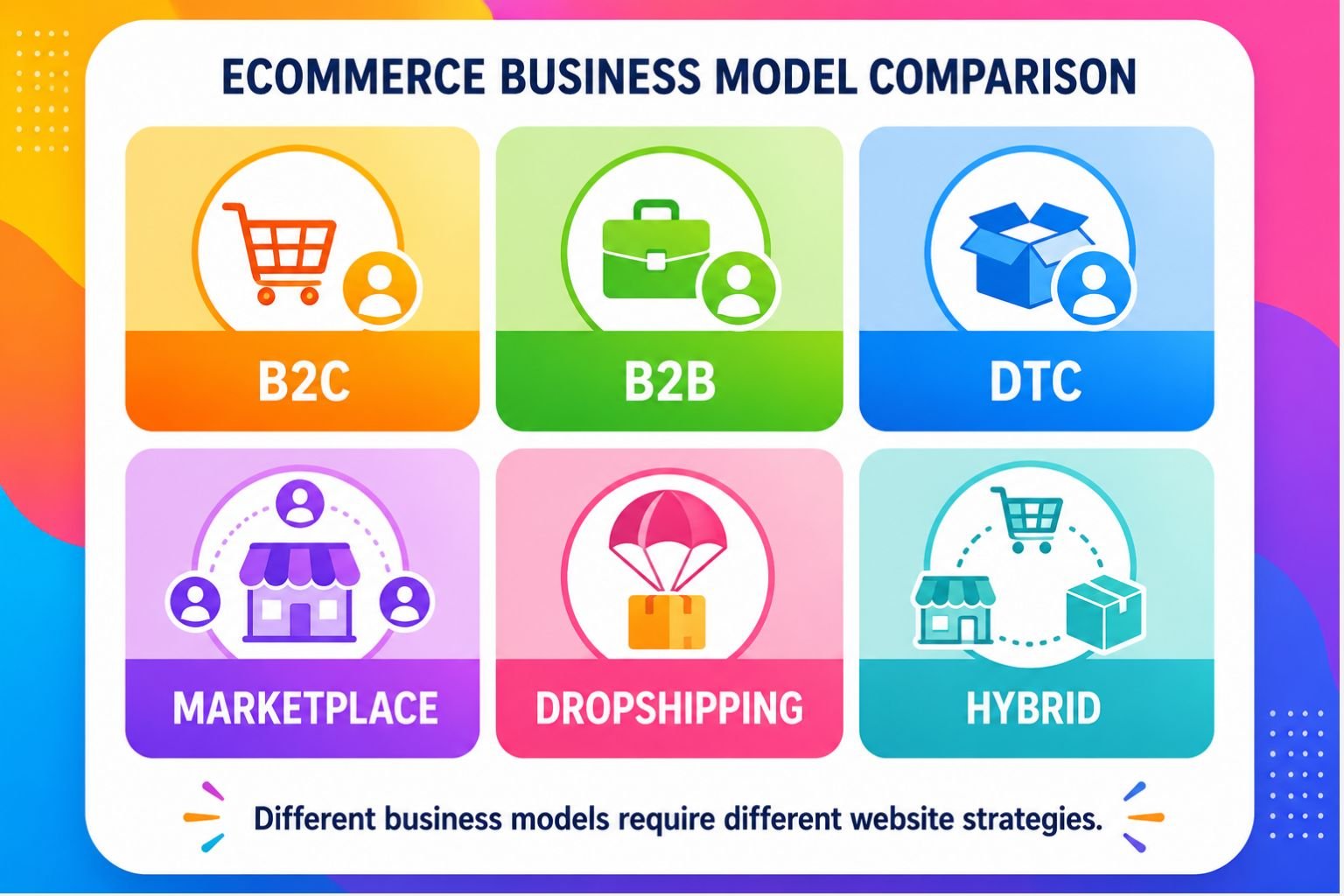
That’s why choosing the right ecommerce business model is one of the most important decisions during the planning stage.
Your business model influences everything from website structure and product pages to pricing, customer experience, and marketing strategy.
Let’s explore the most common ecommerce business models and what each one requires.
4.1 B2C (Business-to-Consumer)
B2C is the most common ecommerce model.
In this model, businesses sell products directly to individual consumers.
Examples include online clothing stores, beauty brands, electronics retailers, and home decor shops.
Pros
- Simple buying process
- Large customer base
- Faster purchasing decisions
Cons
- High competition
- Customer acquisition can be expensive
- Lower average order values
Website Requirements
- User-friendly navigation
- Strong product pages
- Customer reviews
- Mobile-friendly checkout
- Fast loading speeds
For most ecommerce startups, B2C is often the easiest model to launch and scale.
4.2 B2B (Business-to-Business)
B2B ecommerce focuses on selling products or services to other businesses rather than individual consumers.
Examples include wholesale suppliers, manufacturers, and software providers.
Pros
- Higher order values
- Long-term client relationships
- Predictable revenue opportunities
Cons
- Longer sales cycles
- More complex purchasing processes
- Fewer potential customers
Website Requirements
- Detailed product information
- Quote request forms
- Account-based pricing
- Bulk ordering functionality
- Professional content and trust signals
B2B websites often prioritize information and relationship building over quick transactions.
4.3 DTC (Direct-to-Consumer)
Direct-to-Consumer brands sell directly to customers without relying on distributors, wholesalers, or retail stores.
Many modern ecommerce brands use this model because it gives them greater control over the customer experience.
Pros
- Higher profit margins
- Strong brand control
- Direct customer relationships
Cons
- Full responsibility for marketing and fulfillment
- Higher customer acquisition costs
- Requires strong brand positioning
Website Requirements
- Compelling brand storytelling
- Conversion-focused product pages
- Email marketing integration
- Customer retention features
- Personalized shopping experiences
DTC websites succeed when they build strong connections with their audience.
4.4 Marketplace
A marketplace connects multiple sellers with buyers through a single platform.
Well-known examples include Amazon, Etsy, and eBay.
Pros
- Large product selection
- Multiple revenue opportunities
- Scalability potential
Cons
- Complex platform management
- Seller quality control challenges
- Higher development requirements
Website Requirements
- Vendor registration systems
- Seller dashboards
- Product approval workflows
- Advanced search and filtering
- Multi-vendor management tools
Marketplace websites are significantly more complex than traditional ecommerce stores.
4.5 Dropshipping
With dropshipping, businesses sell products without holding inventory.
When an order is placed, the supplier ships the product directly to the customer.
Pros
- Low startup costs
- Minimal inventory risk
- Easy product testing
Cons
- Lower profit margins
- Limited control over fulfillment
- Supplier dependency
Website Requirements
- Reliable product catalogs
- Inventory synchronization
- Supplier integrations
- Clear shipping information
- Strong customer support systems
Dropshipping can be a good starting point, but success often depends on supplier reliability and niche selection.
4.6 Hybrid Models
Many successful ecommerce businesses combine multiple business models.
For example, a brand may sell directly to consumers while also offering wholesale partnerships. Others may operate a DTC store alongside a marketplace presence.
Pros
- Diversified revenue streams
- Greater business flexibility
- Expanded growth opportunities
Cons
- Increased operational complexity
- More management requirements
- Additional website functionality needed
Website Requirements
- Flexible website architecture
- Multiple customer pathways
- Scalable ecommerce platform
- Advanced user and product management
The right ecommerce business model depends on your goals, products, target audience, and growth strategy.
Choosing the right model early helps you build a website that supports your business today while preparing for future growth.
Section 5 — Plan Your Product Catalog Structure
Imagine walking into a supermarket where products are placed randomly.
Snacks are mixed with cleaning supplies. Drinks are scattered across different aisles. There are no signs to help you find what you need.
Frustrating, right?
Now imagine your customers feeling the same way when they visit your ecommerce website.
No matter how great your products are, poor product organization can make shopping difficult and reduce sales.
That’s why planning your product catalog structure is one of the most important parts of ecommerce website planning.
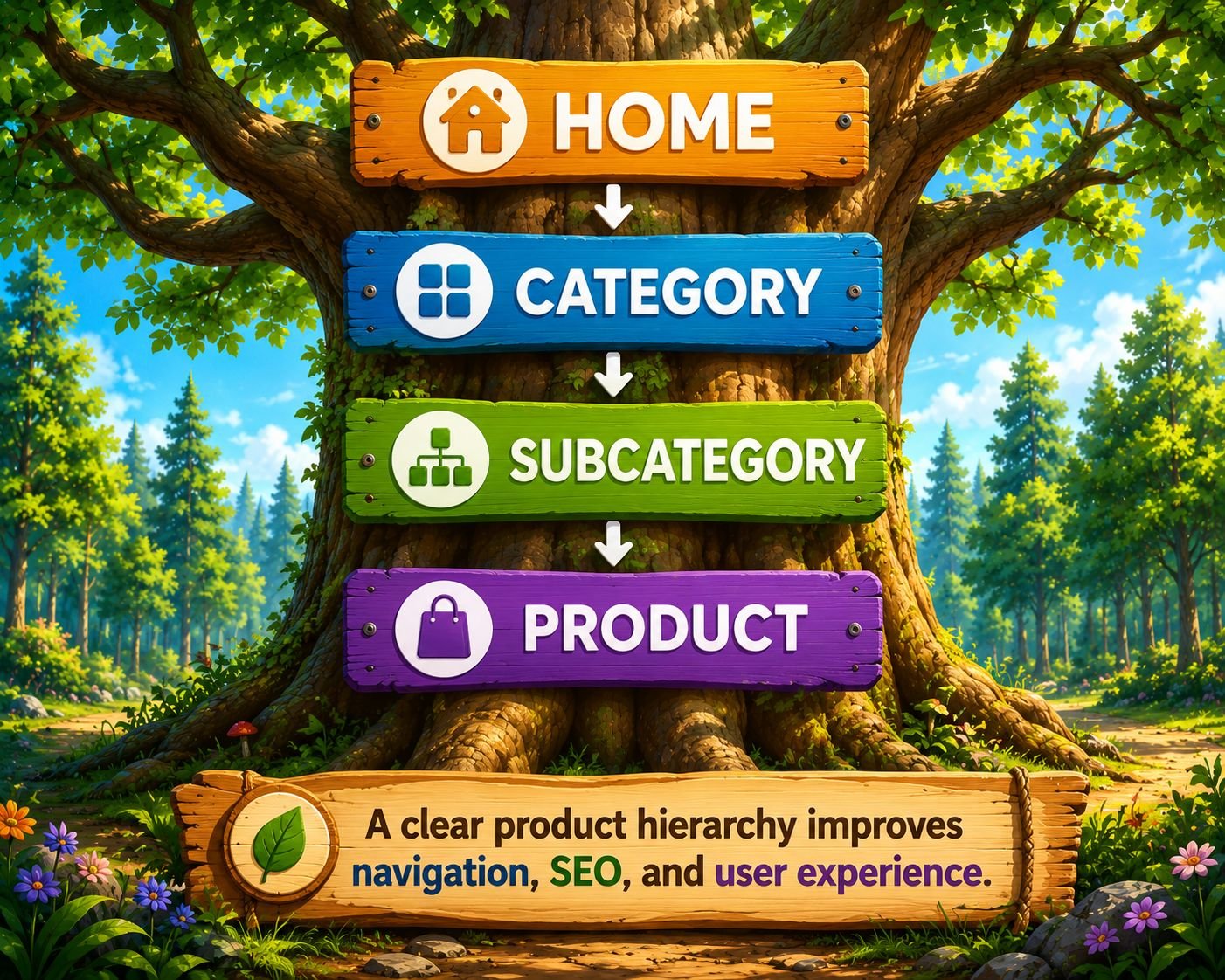
A well-organized catalog improves user experience, supports SEO, and makes it easier to scale your business as your product range grows.
5.1 Product Categories
Product categories are the foundation of your ecommerce website structure.
They help customers quickly understand what your store offers and where they should go to find specific products.
For example, an online fashion store might use categories such as:
- Men’s Clothing
- Women’s Clothing
- Footwear
- Accessories
Your categories should be broad enough to cover major product groups but specific enough to help customers navigate efficiently.
The goal is simplicity.
If visitors have to think too hard about where a product belongs, your category structure probably needs improvement.
5.2 Subcategories
As your product catalog grows, categories alone may not be enough.
That’s where subcategories become valuable.
Continuing with the fashion store example, the “Men’s Clothing” category could contain subcategories such as:
- Shirts
- T-Shirts
- Jeans
- Jackets
Subcategories help break large product collections into smaller, easier-to-browse sections.
They also improve website organization and help customers find products faster.
A good rule is to create subcategories only when they genuinely improve navigation and usability.
5.3 Filters
Filters allow shoppers to narrow down product options without leaving a category page.
This is especially important for ecommerce stores with large inventories.
For example, customers shopping for running shoes may want to filter products by:
- Size
- Color
- Brand
- Price
- Customer Rating
Without filters, visitors may need to browse dozens or even hundreds of products before finding the right option.
Filters create a smoother shopping experience and reduce friction throughout the buying process.
5.4 Tags
Tags provide another layer of product organization.
Unlike categories and subcategories, tags are typically used to connect products that share specific characteristics.
Examples include:
- New Arrival
- Best Seller
- Summer Collection
- Eco-Friendly
- Limited Edition
Tags can help customers discover related products and improve product discovery across your website.
However, tags should be used strategically.
Creating too many unnecessary tags can make your website difficult to manage and may create SEO challenges if not handled properly.
5.5 Product Variations
Many ecommerce products come in multiple versions.
A single product may be available in different sizes, colors, materials, styles, or configurations.
For example, a t-shirt may be available in:
- Small
- Medium
- Large
And in multiple colors.
Instead of creating separate product pages for every option, product variations allow customers to choose their preferred version from a single page.
This creates a cleaner shopping experience and prevents unnecessary duplication across your website.
5.6 Internal Linking
Internal linking helps connect different parts of your ecommerce website.
For example, category pages can link to relevant subcategories, while product pages can link to related products or complementary items.
These links help customers discover more products and stay engaged longer.
They also help search engines understand the relationship between different pages on your website.
A strong internal linking strategy improves both usability and SEO performance.
5.7 Why Product Catalog Structure Matters
A well-planned product catalog does more than organize products.
It creates a foundation for long-term ecommerce success.
Scalability
Many stores launch with a small number of products but expand over time.
A scalable catalog structure allows you to add new categories, products, and collections without creating confusion or requiring major restructuring.
Planning for growth today can save countless hours of work in the future.
User Navigation
Customers should be able to find products quickly and effortlessly.
A logical category structure, clear subcategories, helpful filters, and effective internal links all contribute to a better shopping experience.
The easier it is to navigate your store, the more likely customers are to complete a purchase.
SEO Benefits
Search engines rely on website structure to understand your content.
Well-organized categories, clean navigation, logical internal linking, and properly structured product pages make it easier for search engines to crawl and index your website.
This can improve visibility in search results and help attract more organic traffic over time.
In short, your product catalog structure is much more than an organizational system. It’s a critical part of user experience, ecommerce SEO, and long-term business growth. Building it correctly from the start creates a stronger foundation for both customers and search engines.
Section 6—Create an Ecommerce Website Content Plan
Imagine building an ecommerce website where every page exists for a reason.
Visitors always know where to go next. Questions are answered before they’re asked. Products are easy to discover. And every page helps move customers closer to a purchase.
That’s exactly what a good content plan does.
Many ecommerce businesses focus heavily on design and products but pay little attention to content planning. As a result, they end up with missing pages, inconsistent messaging, and gaps in the customer journey.
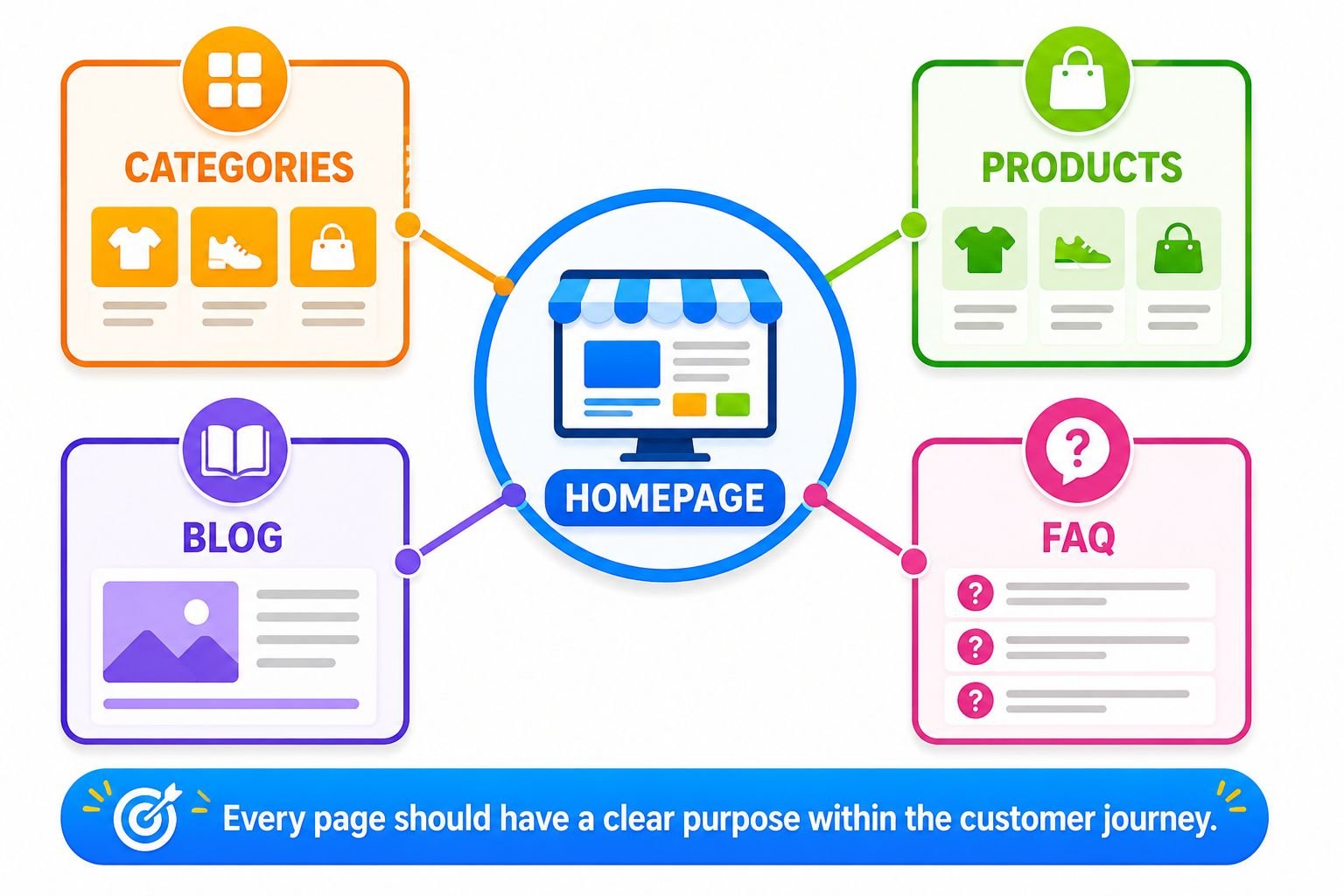
A strategic ecommerce content plan ensures that every page serves a purpose and contributes to a better user experience.
6.1 Homepage Content
Your homepage is often the first impression visitors have of your brand.
It should quickly communicate who you are, what you sell, and why customers should choose you.
A strong homepage typically includes:
- Clear value proposition
- Featured products or categories
- Trust signals
- Customer reviews
- Promotional offers
- Calls-to-action
The goal isn’t to tell visitors everything.
The goal is to guide them toward the next step.
6.2 Category Pages
Category pages help customers explore groups of related products.
These pages should do more than simply display products.
Effective category pages often include:
- Category descriptions
- Product filters
- Sorting options
- Featured products
- Internal links
Well-optimized category pages also create valuable SEO opportunities by targeting broader product-related keywords.
6.3 Product Pages
Product pages are where buying decisions happen.
This is often the most important content on an ecommerce website.
Every product page should provide the information customers need to purchase with confidence.
This may include:
- Product descriptions
- Images and videos
- Features and benefits
- Specifications
- Reviews
- Shipping information
- Frequently asked questions
The better your product content is, the easier it becomes to convert visitors into customers.
6.4 About Page
Many businesses underestimate the importance of their About page.
Customers want to know who they’re buying from.
Your About page helps tell your brand story, explain your mission, and build credibility.
It’s an opportunity to create a human connection with your audience.
People often trust brands more when they understand the people and values behind them.
6.5 FAQ Page
Customers often have similar questions before making a purchase.
Instead of forcing them to contact support, your FAQ page can provide quick answers.
Common FAQ topics include:
- Shipping
- Returns
- Payments
- Product information
- Order tracking
A helpful FAQ page reduces friction, improves customer experience, and can even increase conversions.
6.6 Blog Content
Many ecommerce businesses overlook blogging.
That’s a mistake.
A blog can help attract organic traffic, answer customer questions, and establish topical authority within your industry.
For example, a skincare brand might publish content about skincare routines, ingredient guides, and common skin concerns.
A furniture store might create content about interior design and home organization.
Helpful blog content attracts potential customers long before they’re ready to buy.
6.7 Policy Pages
Policy pages may not be exciting, but they’re essential.
These pages help establish trust and protect both the business and the customer.
Important policy pages often include:
- Privacy Policy
- Shipping Policy
- Return Policy
- Refund Policy
- Terms and Conditions
Clear policies help customers feel more confident when purchasing from your website.
6.8 Content Mapping, Content Gaps, and User Journey Alignment
Creating content isn’t enough.
You also need a plan for how every page fits together.
This process is known as content mapping.
Content mapping helps you connect content with different stages of the customer journey.
As you build your content plan, look for content gaps.
These are important questions, concerns, or topics that your website doesn’t currently address.
For example, customers may want information about sizing, product comparisons, or shipping expectations.
Finally, make sure your content aligns with the user journey.
A visitor discovering your brand for the first time needs different information than someone ready to purchase.
When your content supports customers at every stage of their journey, your ecommerce website becomes more useful, more trustworthy, and more effective at generating sales.
A successful ecommerce website isn’t built around random pages.
It’s built around a content plan that guides visitors from discovery to purchase.